
Telomeres
Previously:
Before the discovery of the epigenome, we saw
We all know what causes accelerated ageing.
Eating too much and drinking too much
In the introduction to this series, attention was drawn to the first book that describes the importance of a healthy lifestyle. But in fact, a great deal was already known among the ancient Greeks.
Thus stated the Greek physician Hippocrates (460 BC – 377 BC):
“If we could give every individual the right amount of nourishment and exercise, not too little and not too much, we would have found the safest way to health.”
The name Hippocrates is associated with a collection of texts that have been recorded and is known as:
Hippocratic Corpus
It concerns a collection of some 60 medical writings from antiquity (approx. 400 BC), recorded by Hippocrates and his disciples. Within that collection, there are a few that deal directly with lifestyle, such as: On Regimen
This text is explicitly about: nutrition, exercise, sleep.

Hippocrates
The concept of “health” gets a boost
“Don't be foolish, follow your doctor's advice: smoke a new cigarette.”
From the 1930s to the 1950s, the most powerful advertising slogan for smoking – “doctors recommend” – was coupled with the world's deadliest consumer product.
Just in the period when smoking was presented as healthy, the friction began. Advertisements with doctors and reassuring slogans inspired confidence, despite the fact that the relationship between smoking and lung cancer was already known back then.
From that moment on, a tension arose between science and industry. While independent research provided increasingly strong evidence, the tobacco industry tried to sow doubt and reassure the public.

Smoking is healthy...
Who is telling the truth?
That contrast made people aware for the first time of a fundamental question: who is telling the truth here?
A major breakthrough came in 1950, when large-scale research by Richard Doll and Austin Bradford Hill, among others, conclusively demonstrated that smokers had a much higher risk of lung cancer.
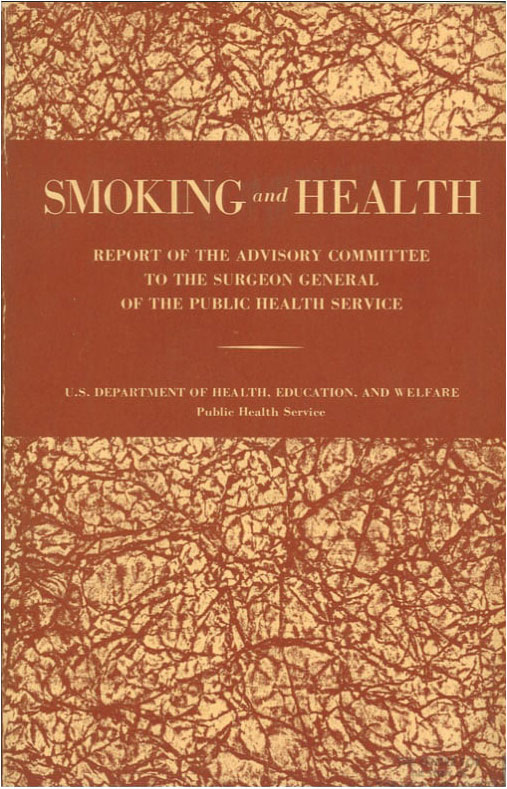
The tipping point
But the real turning point only followed in 1964 (!), with the report of the U.S. Surgeon General, which officially established that smoking causes serious health risks. Trust in advertising and authority then gives way to a growing need for independent evidence. From that moment on, the way we look at health also changes. It is no longer about what sounds plausible, but about what is demonstrably correct.
That report initiates a development that eventually leads to where we are now.
Incidentally, we already see a certain form of public information campaign emerging earlier on, which emphasises the importance of eating well and getting enough exercise.
The well-known “Wheel of Five” from the Nutrition Centre was first launched in 1953.

In the early 2000s, the first publications by Dan Buettner appeared (including in the National Geographic Society). In 2008, the book The Blue Zones was published
Blue Zones
The shift from general health to “living longer” then receives widespread attention through a series about Blue Zones on National Geographic.
This series investigates areas where people remarkably often reach an advanced age, the so-called “blue zones”. The map shows these areas.
What these areas have in common is a lifestyle: simple food, plenty of exercise, social connection and low chronic stress. This shifts public attention from merely “staying healthy” to actively extending lifespan.
What makes these insights extra interesting is that we now better understand why this lifestyle actually works.
The daily habits that are taken for granted in the blue zones appear to influence processes in the body that we now link to measurements of the epigenome. This gives the idea of living longer an increasingly concrete, biological basis.
Longevity
Attention to “longevity” — the active extension of a healthy life — only really starts to gain momentum around the year 2000. Before that, the emphasis is primarily on fighting disease and increasing average life expectancy. In the decades prior, knowledge about the body's structure does grow. In 1953, the structure of DNA is unraveled, and in the years that follow, genes are increasingly well understood. For a long time, it is assumed that this code is decisive and can hardly be influenced. An important step follows in 2003 with the completion of the Human Genome Project. Shortly afterwards, attention shifts: not only the code itself is important, but especially how it is used.
From the 2000s onwards, the insight emerges that genes can be switched on and off via the epigenome. This creates a new perspective: lifestyle influences the way in which our genetic code is expressed. This insight forms the basis for modern thinking about longevity, which focuses not only on living longer, but above all on staying healthy for longer.

The famous Buck Institute for Research on Aging. This institute was established in 1999 as the first longevity research centre.

The first step from cell to measurement “how old are you?”
As chromosomes became increasingly visible under the microscope, researchers discovered their ends: the telomeres.
These protective “caps” appeared to become slightly shorter with each cell division. This provided for the first time a measurable link with ageing. For the first time, one could not only see that we are ageing, but also measure something of that process.
Telomeres thus forming one of the first bridges between biological ageing and measurable processes in the body.

Through a special colouring technique, the telomeres have been made visible here (NASA photo).
Wear and tear and telomeres
What are telomeres?
You can compare telomeres to the plastic tips of a shoelace. They sit at the end of your chromosomes and protect your DNA from damage.
Shortening of telomeres
Each time a cell divides, the telomeres become a little bit shorter. If they become too short, the cell can no longer divide properly.
The cell then stops dividing (this is called senescence) or dies.
This process plays an important role in ageing.
While the epigenome determines how a cell behaves, telomeres primarily determine how long a cell can continue to divide.
The link with the epigenome
The epigenome and telomeres are two different systems, but they do influence each other.
For an initial explanation, it is not necessary to understand that dependency precisely.
Therefore we will not go into this any further.
We are showing another nice video about telomeres.
Thanks to increasingly better measurement and analysis methods, knowledge about DNA and the structures bound to it is increasing rapidly. In the next chapter, we will see how this leads to the recognition of the epigenome.

Answer first and only then click on the question to see what our answer is
Question 1: What did Hippocrates state about health?
Answer: Hippocrates stated that health arises when you find the right balance between nutrition and exercise: not too much and not too little. He thus laid the foundation early on for the idea that lifestyle is important for health.
Question 2: What changed after the 1964 U.S. Surgeon General's report?
Answer: From that moment on, health was no longer based on advertising or authority, but on scientific evidence. People began to take a more critical look at what is truly healthy.
Question 3: What are “Blue Zones”?
Answer: Blue Zones are areas in the world where people live to a remarkably old age. These people often lead healthy lives through simple nutrition, plenty of exercise, social connections and low stress.
Question 4: What changed around the year 2000 in thinking about longevity?
Answer: It was discovered that not only DNA is important, but above all how genes are switched on and off via the epigenome. As a result, it became clear that lifestyle influences ageing.
Question 5: What are telomeres?
Answer: Telomeres are protective ends of chromosomes. You can compare them to the plastic tips of a shoelace that prevent the DNA from getting damaged.
Question 6: Why are telomeres important for ageing?
Answer: Telomeres become shorter with every cell division. If they become too short, the cell stops dividing or dies. As a result, telomeres are one of the first ways in which we can measure ageing in the body.