Science today for a healthier tomorrow
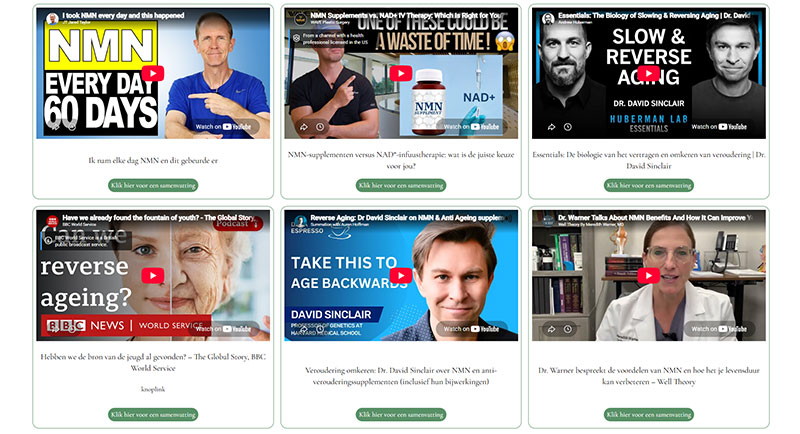
In a WNL broadcast, an expert (namely Prof. Andrea Maijer, who works in Singapore, among other places) discusses a scientific breakthrough in the field of ageing. Twelve mechanisms (the ‘hallmarks of ageing’) have now been identified that explain why cells and organs age [01:18]. The most important news is that it is now possible to reduce people's biological age by 5 to 10 years [03:33].
The focus thereby shifts from ‘lifespan’ to ‘healthy span [06:25]. Using AI and precision medicine, it can be determined per individual which interventions — such as specific medication, supplements or lifestyle adjustments — are needed to slow down or even reverse ageing [05:10].
Although these techniques are already being applied in specialised clinics in countries such as Singapore and Abu Dhabi, the aim is to democratise this care [08:58]. The expectation is that such ‘longevity clinics’ will be integrated into mainstream healthcare within five years, making healthy ageing accessible to everyone [08:20].
Precisely because the well-known David Sinclair claims that by editing a number of genes lifespan can be significantly extended, one might think that Andrea Maier means the same thing. But that is not the case.
The experiments Andrea Maier talks about are programmes where people receive a health approach driven by measurements of methylation. No editing of genes takes place here (so not via the epigenome either).
Yet in the interview you can see a clear wow factor, with those present likely thinking of David Sinclair's approach. It is therefore important to distinguish between:
(1) lifespanactually lengthening life by intervening in genes (Sinclair)
(2) healthspanextending the period in which someone is healthy, through targeted lifestyle interventions based on methylation measurement
You could say: we have known for a long time that we live healthier and longer lives if we watch our lifestyle: eating healthily, exercising enough and avoiding stress. That is not new knowledge. Doctors, researchers and health educators have been emphasising this for decades, and for good reason: anyone who follows these basic rules reduces the likelihood of many chronic conditions and often stays fit for longer.
What does directing that lifestyle based on methylation measurement add, then? That question is, of course, an obvious one. The first answer is indeed: yes, we already achieve a great deal if we follow the known guidelines for healthy living. For many people, that is already a huge step forward.
But it doesn't stop there. Because those general recommendations are general recommendations. They are intended for large groups of people and take little account of individual differences. Whereas we now know that every body reacts differently. What works well for one person might have less effect on another. And that is precisely where measuring the biological clock – via methylation – comes into the picture.
With methylation measurement, we are as it were looking “under the bonnet” of the body. We don't just see how old someone is in calendar years, but also how fast the body is actually ageing. That provides a much more concrete and personalised picture. It makes it visible whether someone is biologically younger or indeed older than expected – and above all: whether lifestyle changes are actually having an effect.
That is the big step forward: from general advice to targeted guidance. Instead of “living healthily is good for you”, we can now say: this specific adjustment to your lifestyle has this effect on you. That makes it not only more personal, but also more motivating. After all, you can see what is happening.
The image shows an offer from a company (TruDiagnostics) of a package that they offer. The text speaks for itself.
Image translation: Pinnacle is our leading flagship programme. It includes the Momentum strategy, complemented by essential repeated, precise measurements after six months. This enables our multidisciplinary team of experts to accurately measure progress, further refine your personal intervention strategy and better understand changes over time, with the aim of optimally supporting your long-term health.
Traditional
The traditional approach:
For everyone the same advice
“Eat healthily”
“Get enough exercise”
“Sleep well”
“Stop smoking”
Characteristics: based on experience
general advice (one-size-fits-all)
risk-based
little measure
low personalisation
Andrea Maier
Now driven by methylation measurements:
From general → personal
no standard advice but a personal approach through measurements: methylation, blood analysis, etc.
to: what happens in your body?
Characteristics: healthspan
Focused on extending the number of healthy years (= healthspan) by fully adapting the lifestyle to individual measurement results that are partly based on epigenetics.
David Sinclair
Interventions at the gene level following Yamanaka's findings
Truly extending lifespan The method is based on findings from animal experiments. Naturally, the Andrea Maier method is also considered alongside this, but the approach is different.
Features: lifespan
Rejuvenating cells (towards the stem cell) so that cells are truly reset. The major hazard is: an incorrect reset increases the risk of tumour formation.
Future
A mix of both methods, in which AI is of great importance. The prospects of increasing the lifespan look positive, but more knowledge is needed.
Human experiments are already being carried out to see what the method can achieve for specific diseases, such as eye diseases.
Characteristics: the ideal mix
The knowledge surrounding healthspan and lifespan is expanding at a tremendous rate and future developments will have major effects.

Naturally, there are more scientists working on seeing how existing advice is substantiated by measurements.
Luigi Fontana is an internationally recognised physician and researcher in the field of nutrition and ageing. He focuses primarily on the question of how lifestyle – and particularly nutrition – can influence the ageing process.
In his research, he shows that a healthy, predominantly plant-based diet and moderate calorie intake lead to a better metabolism, less inflammation and slower biological ageing.
Fontana emphasises that sustainable lifestyle choices are the key to a longer and healthier life. His work aligns closely with modern insights regarding measuring and managing the biological clock.
We are now showing an interview with Luigi Fontana.
Answer: Because David Sinclair talks about intervening in genes to extend lifespan, people think Andrea Maier means the same thing. But Maier works with lifestyle programs based on methylation measurement, without editing genes.
Answer: Lifespan is about extending life itself by intervening in genes. Healthspan is about extending the period during which someone remains healthy, for example by adapting lifestyle based on measurements.
Answer: Because they are intended for large groups of people and do not take individual differences into account. Every body reacts differently, which makes a personal approach important.
Answer: Methylation testing shows how quickly someone is ageing biologically. It provides insight into whether someone is biologically younger or older than their chronological age and whether lifestyle changes are having an effect.
Answer: The transition from general advice to personal guidance. Through measurements, we can see what specifically works for an individual, which makes the process more concrete and motivating.