Reptiles and insects
The animal kingdom contains many more species.
We are not treating all of them, but are now paying attention to the
reptiles and insects
Even more animals
The animal kingdom features an enormous variety of life forms. Of course we cannot discuss all of them, but in this chapter we will examine, amongst other things, a number of striking phenomena in cold-blooded animals: reptiles and amphibians.
For these groups, average lifespans in the wild are often lower than those of the large mammals we discussed earlier. For instance, a lizard lives for an average of about seven years. A frog can theoretically reach the age of ten, but the reality is often very different. The tortoise is the major exception within this group; as is well known, these animals can live to an extreme age.
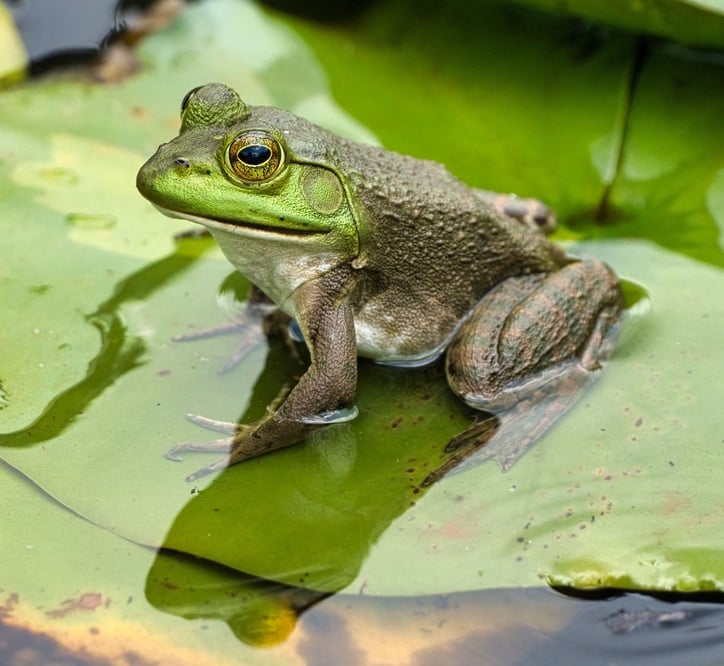
Just as with the mouse, we see enormous differences here between life in the wild and life in captivity. Take the frog as an example:
In the wildLife expectancy here is extremely low. Frogs are at the bottom of the food chain; millions of eggs and tadpoles are eaten by fish, insects and birds. Even as an adult frog, the risks are huge (predators, traffic, habitat loss). Most frogs do not even make it to their first birthday as an adult animal.
In captivityUnder ideal conditions — safe from predators, with controlled temperatures and always enough food — frogs can reach an exceptional age. They then often live 5 to as much as 10 times longer than their wild counterparts.
Regenerative capacity: the internal repair service
A crucial aspect of ageing is the ability of certain animals to repair damage themselves. Think of a simple cut on your finger: your body automatically repairs the damaged skin by creating new cells. Scientists are convinced that this regenerative capacity is the key to understanding ageing processes.
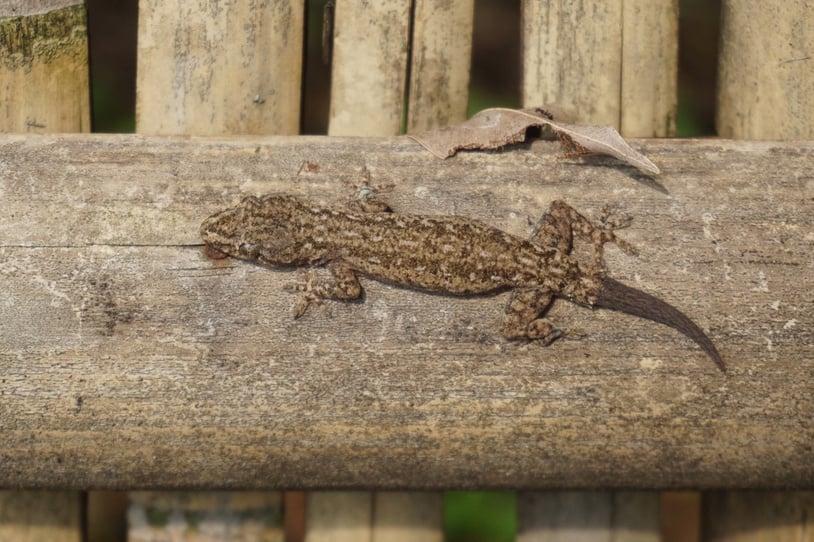
In some animals, we see a bewildering capacity for recovery. Many lizards, for instance, can deliberately release their tail when a predator attacks them. This is a survival strategy, and the body is subsequently capable of regrowing that complete tail — including muscles and nerves — all over again.
At the end of this chapter we will show you even more remarkable examples of animals that have mastered this process to the extreme.
How do limbs regrow in animals?
And why can't people do that?
You can turn on subtitles by using the cog icon in the bottom right.
Summary
The video explains how some animals, particularly the axolotl (a Mexican salamander), are able to regrow a fully functioning limb within six weeks. This process is a biological masterpiece that takes place in a few steps:
The BlastemaAs soon as a salamander loses a limb, skin cells migrate to the wound to seal it. Beneath this, special cells form that together are called the blastema. This is a kind of “repair button” that resembles how a new body part begins to grow in an embryo.
DedifferentiationWhat makes this process unique is that mature cells (such as muscle or bone cells) return to a kind of “default state” (stem cells). They briefly forget their old function in order to be able to become anything again, for example a new leg or tail.
Positional memoryThe cells in the blastema appear to know precisely where they are located and how much needs to be regrown. As a result, an entire leg never grows back if only the tip of a toe is missing.
No scarWhere people mend wounds with scar tissue, which blocks further growth, salamanders often repair tissues without leaving any traces.
Why can't people do this?
Although humans have limited regenerative abilities (such as repairing the liver or the regrowing of fingertips in young children), our body usually blocks large-scale regeneration by forming scars. Scientists are currently researching whether we can activate the “dormant” instructions in our own DNA to copy this trait of the salamander in the future.

Answer first and only then click on the question to see what our answer is
Question 1: To which biological group do frogs officially belong, even though they are discussed together with reptiles in this lesson because of their cold-bloodedness?
Answer: The amphibians.
Explanation: Although, just like reptiles, they are cold-blooded, frogs belong to the amphibians because they undergo a major metamorphosis (from a tadpole with gills to an adult animal with lungs) and have moist skin.
Question 2: Why can captive frogs sometimes live 5 to 10 times longer than their wild counterparts?
Answer: Due to the absence of predators, diseases and extreme weather conditions.
Explanation: In the wild, frogs are at the bottom of the food chain and many do not make it to their first year. In a controlled environment (captivity), their biological potential of around 10 years truly becomes apparent.
Question 3: What happens at a cellular level in a salamander (such as the axolotl) immediately after a limb is lost?
Answer: Adult cells undergo de-differentiation, reverting to a sort of ‘default state’ (think of stem cells).
Explanation: The cells “forget” their specific task as, for example, a muscle or bone cell, so that they can once again become anything required to build the new body part.
Question 4: How do the cells in the blastema (the group of repair cells) know precisely which part of the limb they need to make and when they should stop growing?
Answer: Due to a kind of ‘positional memory’ in the cells.
ExplanationThe cells know exactly where they are in relation to the rest of the body. As a result, an entire leg does not grow back if only a toe is missing, and growth stops as soon as the limb reaches the correct size.
The mayfly – the ant – the cricket
and a bit more about insects
The mayfly
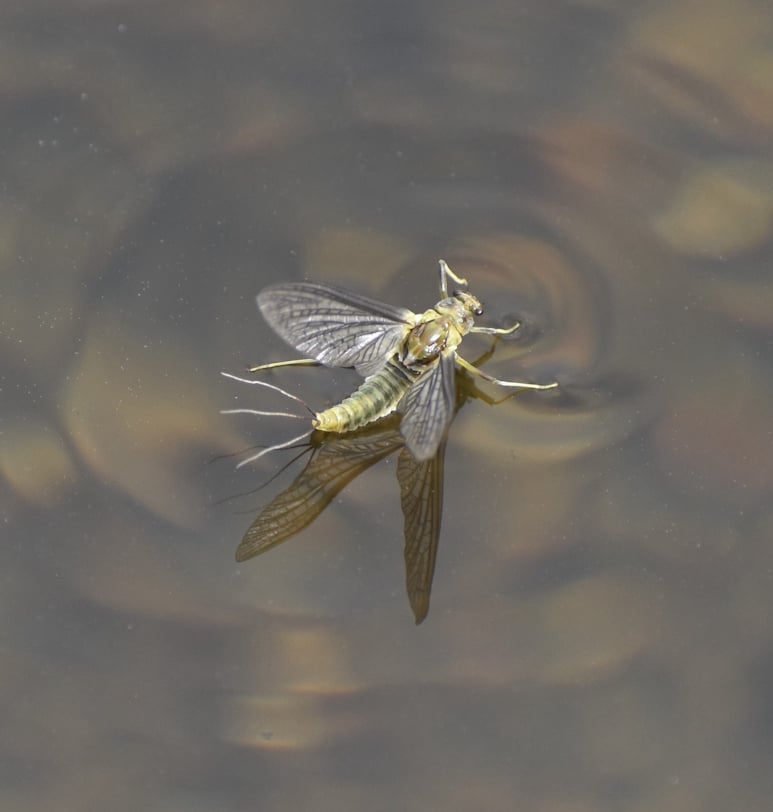
The mayfly owes its name to its extremely short lifespan as an adult insect. These animals, which are called ephemeropterans by biologists, spend the majority of their lives as larvae underwater. This is a period that can last anywhere from one to three years.
As soon as the mayfly develops into an adult insect (the imago), however, everything changes. This stage is entirely dedicated to reproduction. Because their mouthparts and digestive system no longer function, they do not take in any food; their sole mission is to find a mate.
The end is as abrupt as it is impressive: the females of some species cannot even lay eggs in the normal way. Immediately after fertilisation, they let themselves drop dying into the water, offering their own bodies as a sort of ‘food parcel’ to the next generation (see photo). As a result, the total lifespan above water often amounts to just a few hours up to a maximum of a few days
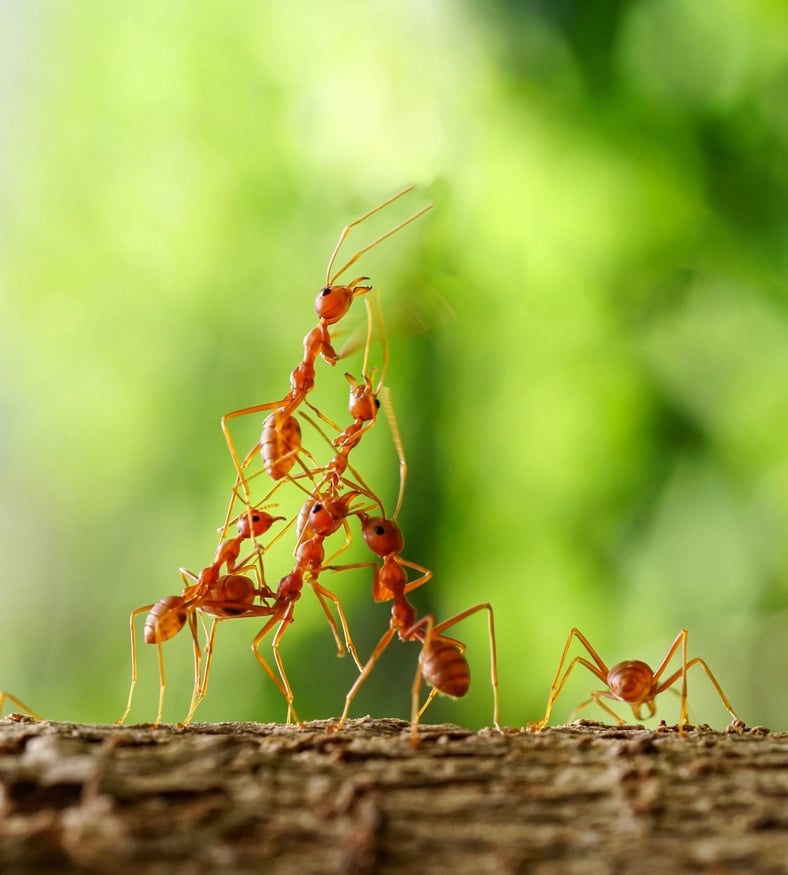
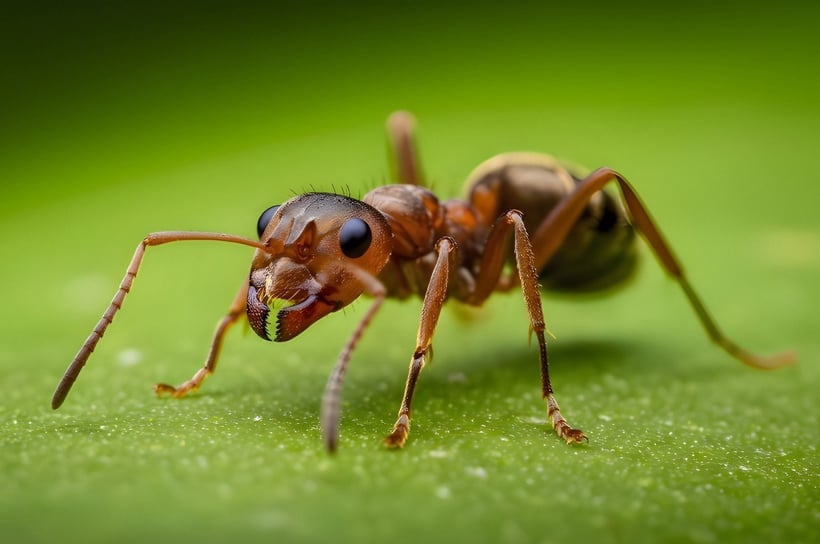
Ants; a life determined by rank and status
How long an ant lives depends entirely on its role within the colony. In this tightly organised society, lifespan is extremely unequally distributed:
1. The Queen: The absolute record-holder
The queen is the beating heart of the colony. Her sole task is laying eggs. Because she lives deep within the nest, is perfectly protected and receives the best nourishment, she reaches a fabulous age for an insect.
Average age: 10 to 20 years is very common, with outliers of up to nearly 30 years.
2. The Cleaners: The tireless forces
Worker ants are infertile females who do all the heavy work: foraging for food, building the nest and caring for the larvae. Their lives are dangerous and physically exhausting, especially when they venture outside the nest.
Average age: 1 to 3 years. Although they are genetically similar to the queen, their hard life means they live up to twenty times shorter.
3. The Men (DarrenA tragically brief existence
Males have only one biological purpose: to mate with a new queen during the spectacular ‘nuptial flight’. They often have wings, but their life force is limited.
Average age: A few weeks to a maximum of two months. > Almost immediately after mating, they die. Males that do not mate often still die quickly from exhaustion or simply because they are no longer fed by the workers and are driven out of the nest.
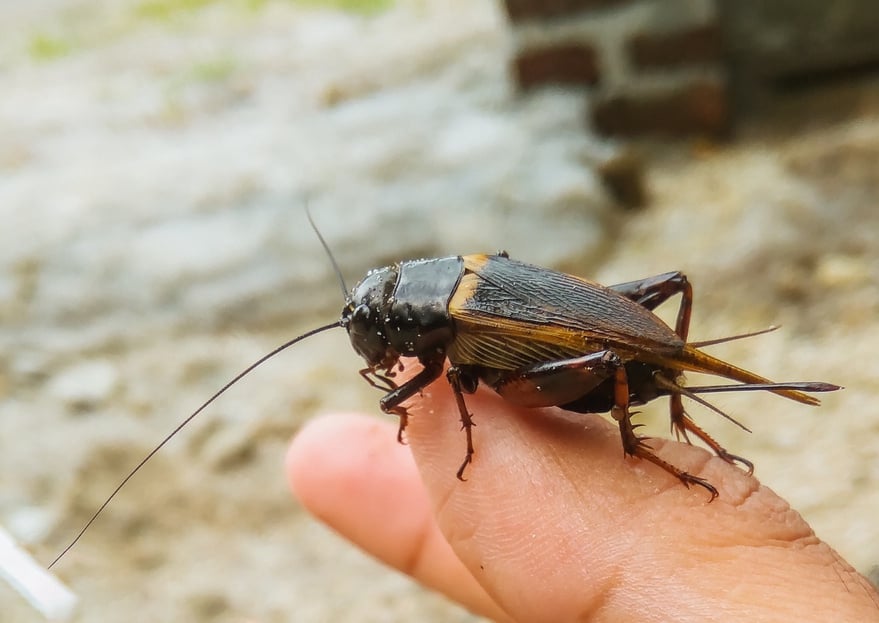
Crickets
On the EOS Wetenschappen website we can read:
…A remarkable study in this field has been underway for some time at the University of Exeter. For more than ten years, British biologists have been following the ups and downs of a field cricket population. The study area is not in Great Britain, but concerns a meadow in northern Spain… (end of quote)
And what turns out to be the case?
…Here, every single field cricket is individually tagged and tracked in true Big Brother style using a network of no fewer than 140 video cameras. This yields a wealth of information on survival and behavioural variation. In field crickets, both sexes are very territorial and defend their patch around a burrow that serves as a refuge. The male clears away the vegetation in front of the burrow, because this arena is where he will chirp. Their study shows convincingly that older males perform less well in this regard. However, there is a lot of variation. For example, the researchers saw that the age-related decline in singing performance differed between years…
Answer first and only then click on the question to see what our answer is
Question 1: The adult mayfly (imago) lives for only a few hours to days. What is the biological reason that they no longer take in food during this stage?
AnswerTheir mouthparts and digestive systems no longer function; their bodies are built purely for reproduction.
Explanation: Because the mayfly has already built up an enormous energy reserve as a larva for that one final day, eating is no longer necessary. Nature has economised on all ‘redundant’ organs to make way for eggs.
Question 2: Within an ant nest, individuals that are genetically almost identical can have completely different life expectancies. Which ant can live to be 10 to 20 years old?
AnswerThe Queen.
Explanation: While worker ants often live for only 1 to 3 years, the queen enjoys a safe, protected environment and optimal nutrition deep within the nest, allowing her to reach a record age for an insect.
Question 3: In the meadow in northern Spain, researchers used 140 video cameras to track field crickets. What was a striking conclusion about the older male crickets?
AnswerTheir singing performance declined as they grew older (senescence).
Explanation: The research showed that old age in crickets is accompanied by physical decline, making them less effective at attracting females on their ‘stage’.
Question 4: The text mentions a 'food parcel'. What is meant by this in the reproduction of certain species of mayfly?
AnswerAfter fertilisation, the female drops onto the water as if dying, with her own body serving as an energy source/food for the environment in which her offspring will grow up.
Explanation: This is an extreme example of how individual survival is completely subordinate to the success of the next generation.
We conclude with 2 species of animal that show a remarkable capacity for regeneration.
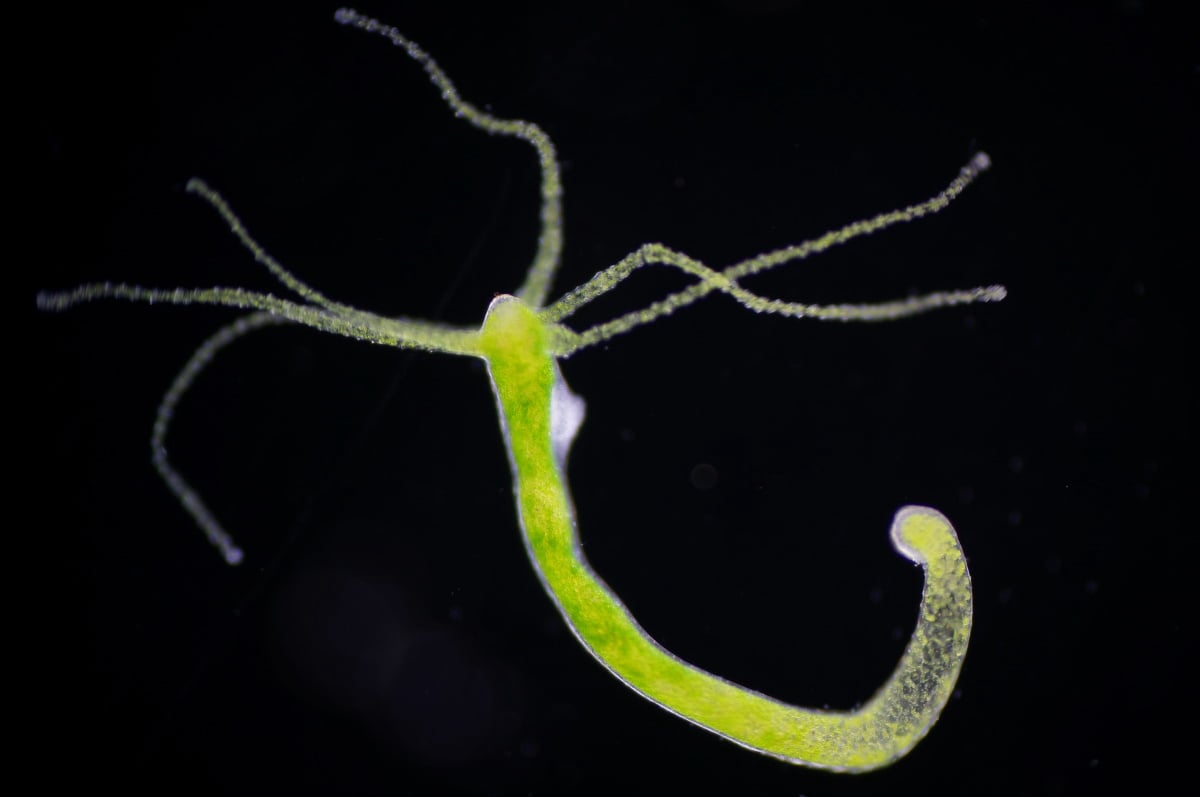
Champions in regeneration (1)
The freshwater polyp called Hydra demonstrates a remarkable capacity for regeneration. That name is derived from the Greek myth about the multi-headed monster, the Lernaean Hydra. In that myth, it was a multi-headed monster that was difficult to defeat because every head that was chopped off the body grew back twice over. Talk about regenerative capacity…
We read on Wikipedia:
•..Biologists are particularly interested in hydra because of their regenerative capacity: they do not age and do not die of old age. In 1998, Daniel Martinez claimed in Experimental Gerontology that hydra are biologically immortal. Further research appears to confirm this statement. Hydra stem cells have the ability to renew themselves indefinitely… (end of quote)
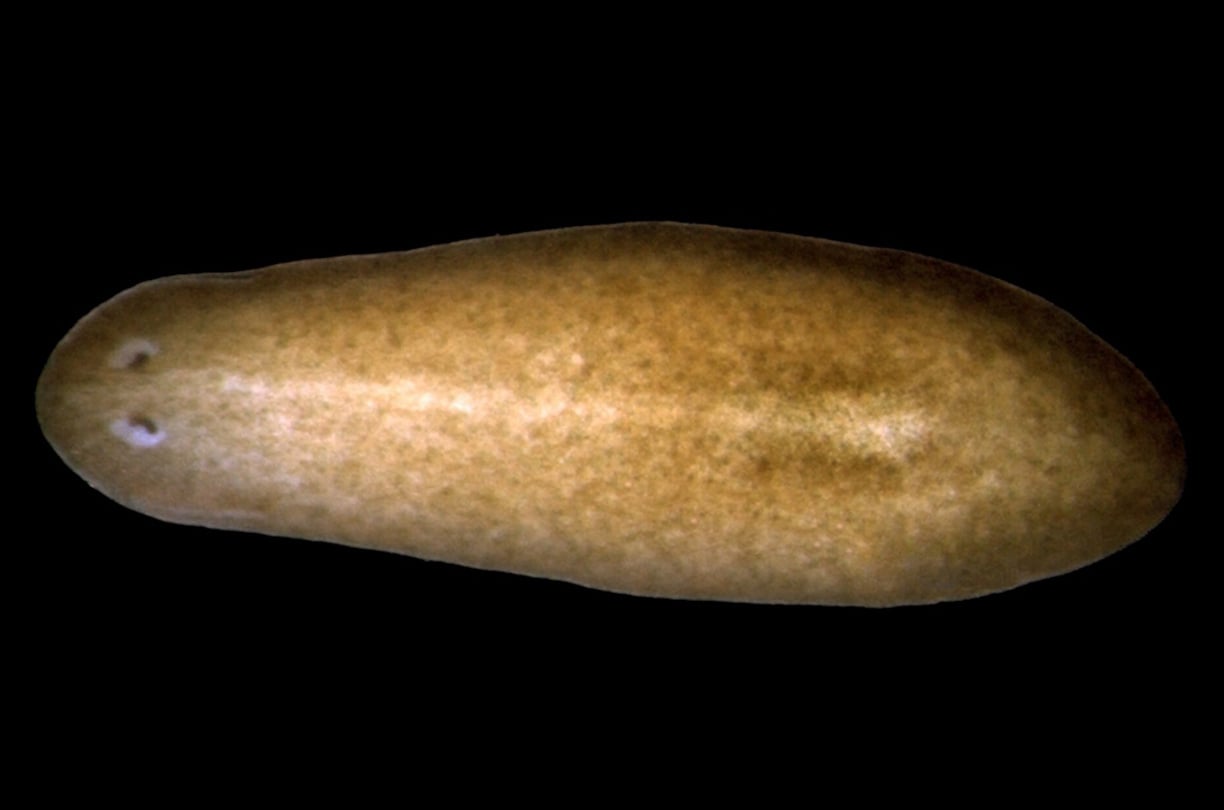
Champions in regeneration (2)
But there is one worm that we must hail as the true champion of regeneration. It concerns the flatworm Schmidtea mediterranea, a species found in the Mediterranean region. Researchers are studying this little creature intensively, because its capacity for self-renewal provides crucial clues about how cells age and how tissue repair works.
On the science website NEMO Kennislink, researcher Stijn Mouton from the ageing institute ERIBA (UMC Groningen) is interviewed about this ‘superworm’.
We quote:
“Even more remarkable is their wonderfully large regenerative capacity. With us, a cut will heal if it isn't too large, but in the superworm, any arbitrary body part can regrow — even the head. If you cut one worm into five pieces, you end up with five worms,” Mouton says. “Not only do those pieces keep wriggling, but within two weeks they fully regenerate into new, complete little worms.'.“
Why is regeneration so important? Because regeneration is the proof that those animals carry a kind of cookbook with them to renew themselves!
Answer first and only then click on the question to see what our answer is
Consider this proposition: regeneration is reminiscent of having a kind of recipe book on how regeneration should take place. Why is this proposition correct?
The answer lies in the information provision: if a small fragment of a planarian worm is capable of building a completely new head, including a brain and eyes, this means that the “blueprint” of the entire worm must be present in that small fragment. The cells have not only the ingredients, but also the complete recipe book to restore the organism from scratch.

Assignment
Read the following article article: https://www.nemokennislink.nl/publicaties/de-paradox-van-de-onsterfelijke-kwal
Study the following four engaging questions that directly connect to the article about the immortal jellyfish and invite reflection:
1. How can the jellyfish Turritopsis dohrnii reverse its life cycle and become young again, whilst other animals cannot?
2. Why do scientists refer to “biological immortality” with this jellyfish, given that the animal can still die?
3. Welke rol spelen cellen en DNA-processen bij het vermogen van de kwal om zijn lichaam opnieuw op te bouwen?
4. Wat kunnen onderzoekers van deze kwal leren over veroudering en levensverlenging bij mensen?