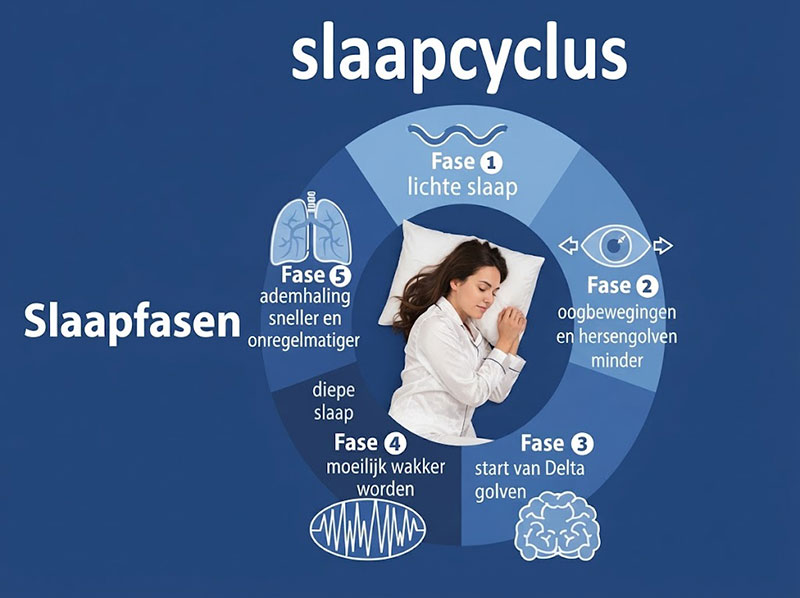
Sleep stages
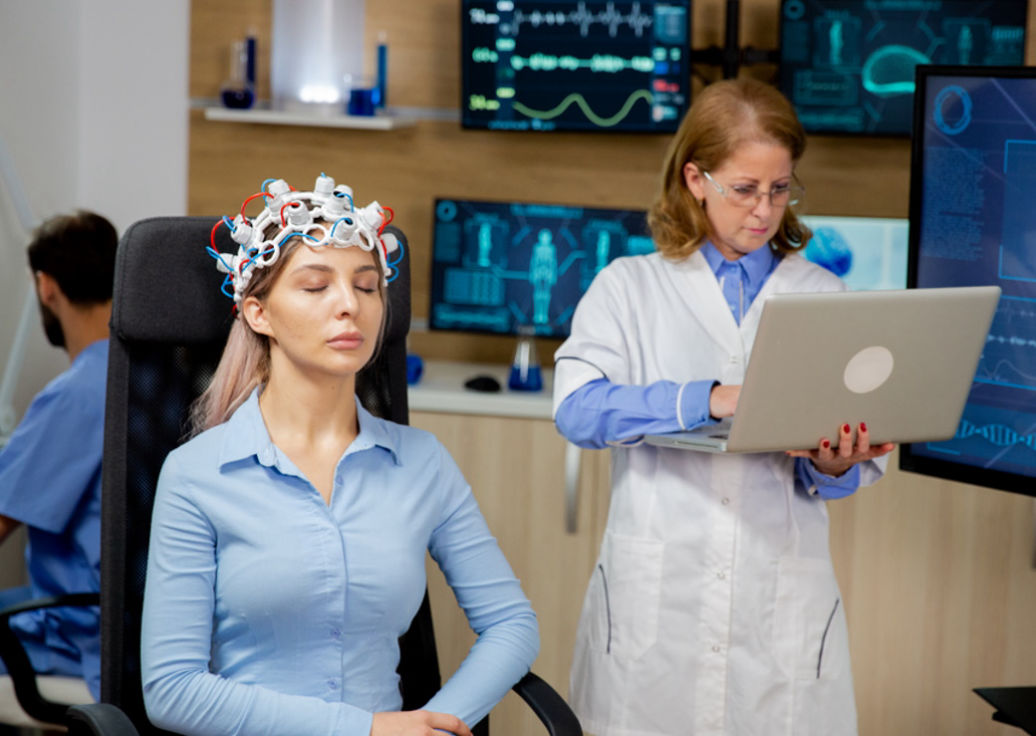
Recording of brain activity
Our brains contain billions of cells which, when active, also cause electrical activity. When we measure this brain activity using electrodes attached to the scalp, we call it “performing an EEG”. The abbreviation EEG stands for Electroencephalogram. The term electro naturally refers to electrical activity, the term encephalo refers to the “brain”, and gram refers to making a recording of that activity. You see all sorts of undulating lines on an EEG. We therefore often refer to brain waves.
It looks scary… all those “things” on your head, but it isn't. The net holds the various electrodes in place and because nothing is “poked in”, it doesn't hurt at all… although many people find this picture quite scary.
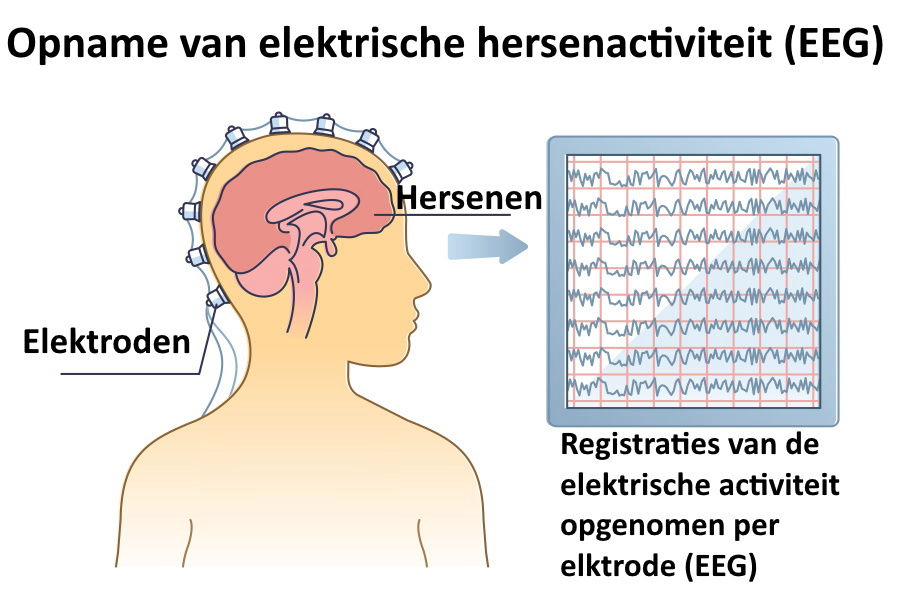
What are we looking at
Here you can see the electrodes attached to the scalp once again. The electrical activity can now be recorded for each individual electrode and registered on paper. Such a recording is therefore called an EEG.
Important
The definitions of the various stages of sleep are defined by looking at the EEG. For example, we can recognise deep sleep by the slow waves in the recordings.
As experts conduct sleep research, this will therefore usually also be done using these kinds of recordings.
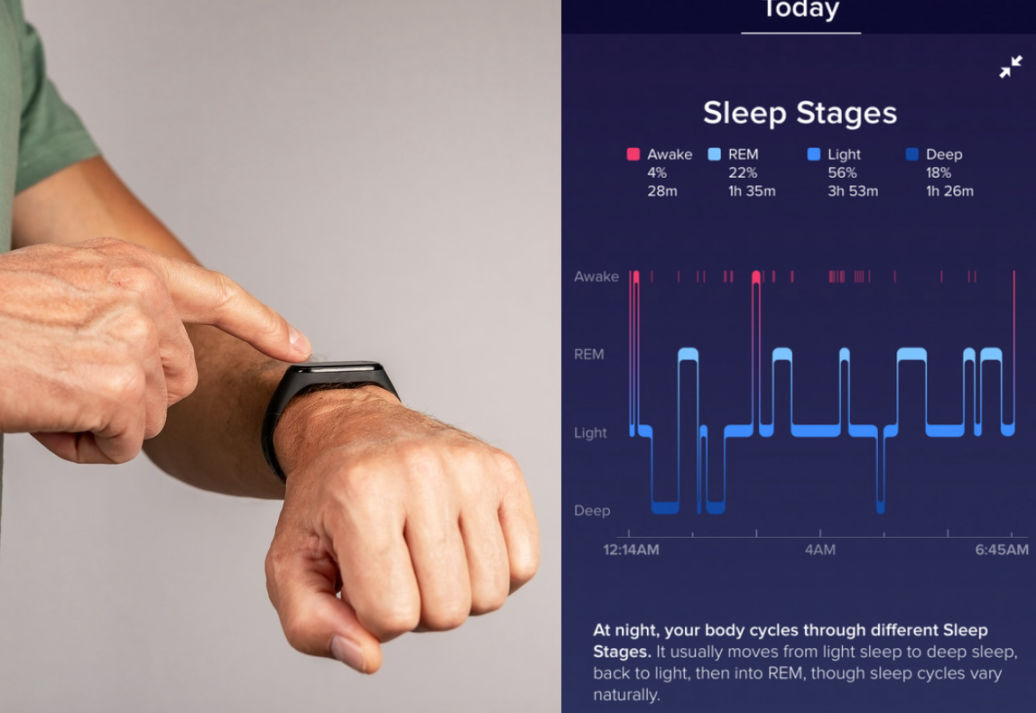
Warning when using a smartwatch
We would point out here that many people think you can also recognise these sleep stages with your smartwatch. The screen of such a smartwatch even displays the term “sleep stages”. But by definition, that is simply not the case. After all, a smartwatch is not capable of measuring EEG patterns. That does not alter the fact that this smartwatch data can also be interesting for some people because it gives them feedback on their sleep as well. Experts do not yet agree on how much value should be attached to that.
Phase 1
You fall asleep
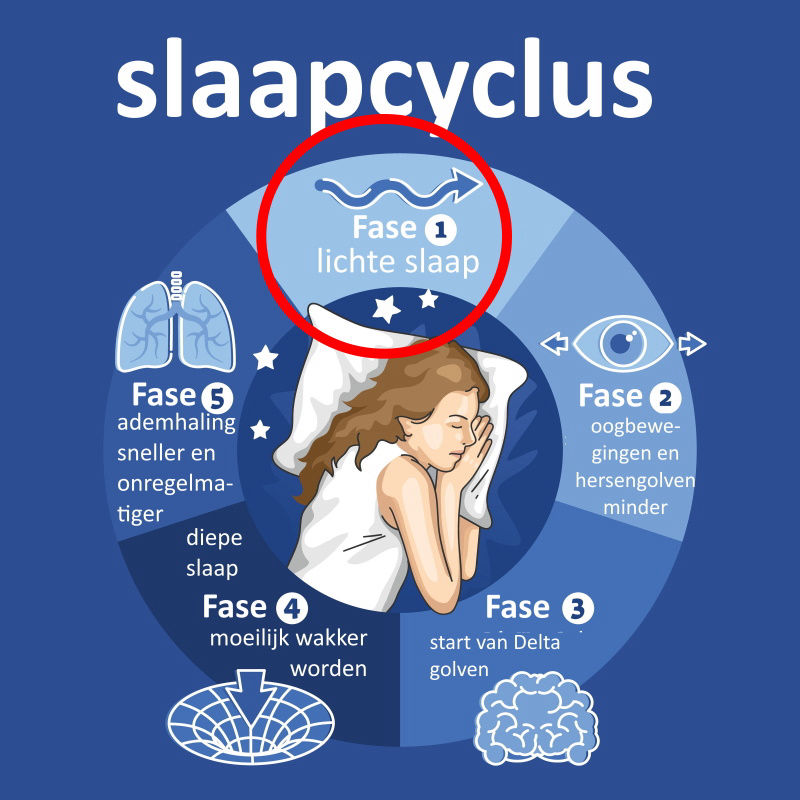
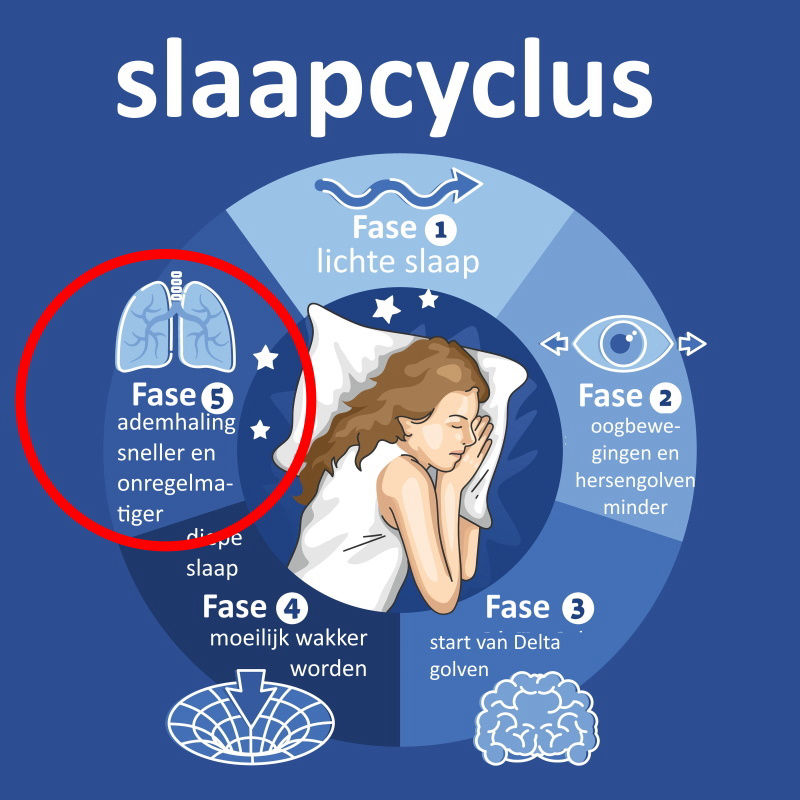
The first sleep stage, also known as non-rapid eye movement (NREM) sleep, is a sleep stage characterised by slower brainwaves and relatively little movement. It is the first sleep stage that occurs during a typical night's rest. It is often also referred to as light sleep.
During this phase, your body begins to relax and on the EEG we see that the waves are slowing down. Your heart rate and blood pressure also drop and your muscles become more relaxed. It is the period in which you drift off to sleep. This phase is short: it usually only takes a few minutes. After that, you enter sleep phase 2.
Phase 1 is part of the entire sleep cycle
It is normal to go through all the sleep stages multiple times during a single night. A cycle lasts about 90 to 110 minutes. Therefore, it is quite normal to wake up briefly from time to time during the night.
Aside: the designation REM is a contraction of the English term Rapid Eye Movements

What is important when falling asleep
Important for being able to fall asleep are:
the moment you go to sleep and therefore also have the desire to fall asleep. The moment of going to sleep will depend heavily on your biorhythm, which means your biological clock, whether you are a morning person (early to bed) or an evening person (late to bed). In the introduction to this course we already discussed the biological clock and we saw that the function of that clock is performed by a group of cells in the brain. The operation of the clock depends heavily on light and therefore on the day-night rhythm. Looking at screens is perceived by the clock as “oh it is still day” and that is the reason that looking at screens in the evening has the effect that you find it difficult to fall asleep.
In short: darkness triggers melatonin production, helping you fall asleep more easily, while exposure to light does the opposite: it wakes you up again.
2. how your daytime activities have been. Generally speaking, if you have been very active, you will also be tired (you build up “sleep pressure”) and will therefore fall asleep sooner. In older people, activity decreases and therefore so does what is known as “sleep pressure”.
3. how active you are when you go to bed. If you are, so to speak, “hyper: you're constantly worrying”, falling asleep will also become more difficult.
Notice how falling asleep here primarily depends on psychological factors, which makes learning “to fall asleep” more difficult. It is not for nothing that we speak of a necessary behavioural change when solving the problems.
Phase 2
Now you really are sleeping
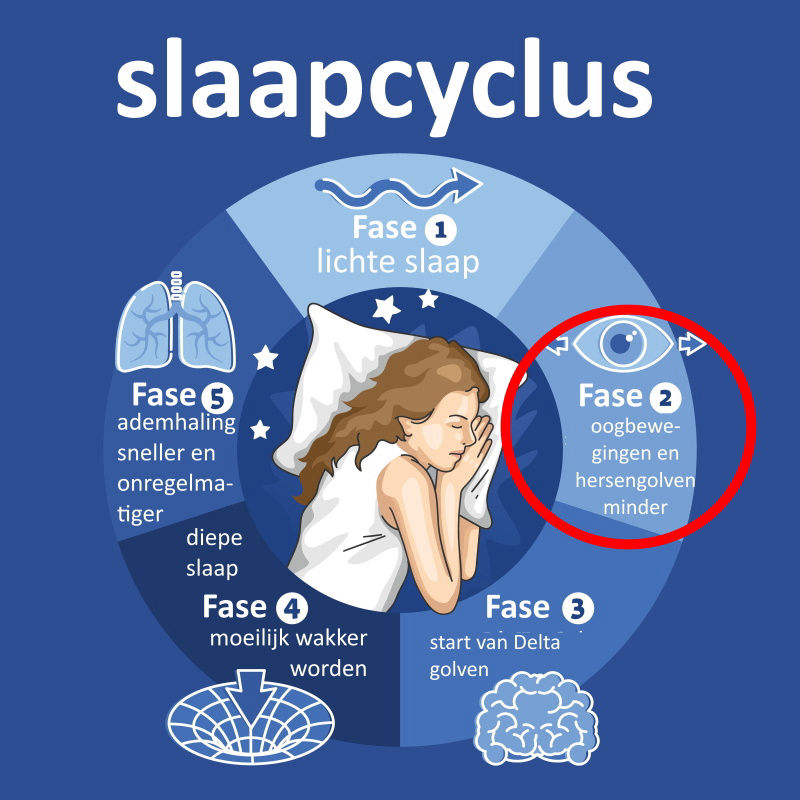
We are picking up where we left off regarding the sleep stages. The second sleep stage is also part of non-rapid eye movement (NREM) sleep.
During the second sleep stage, the brainwaves you see on your EEG become slower. Your muscles will relax even more. Body temperature also begins to drop. This period usually lasts 20 to 45 minutes.
When consuming alcohol
With alcohol consumption, this and the subsequent phase will almost be skipped, and one thus quickly reaches the phase characterised by “deep sleep”.
Alcohol disrupts the proper sleep pattern and in that sense always causes problems.
Phase 3
Off to a deep sleep
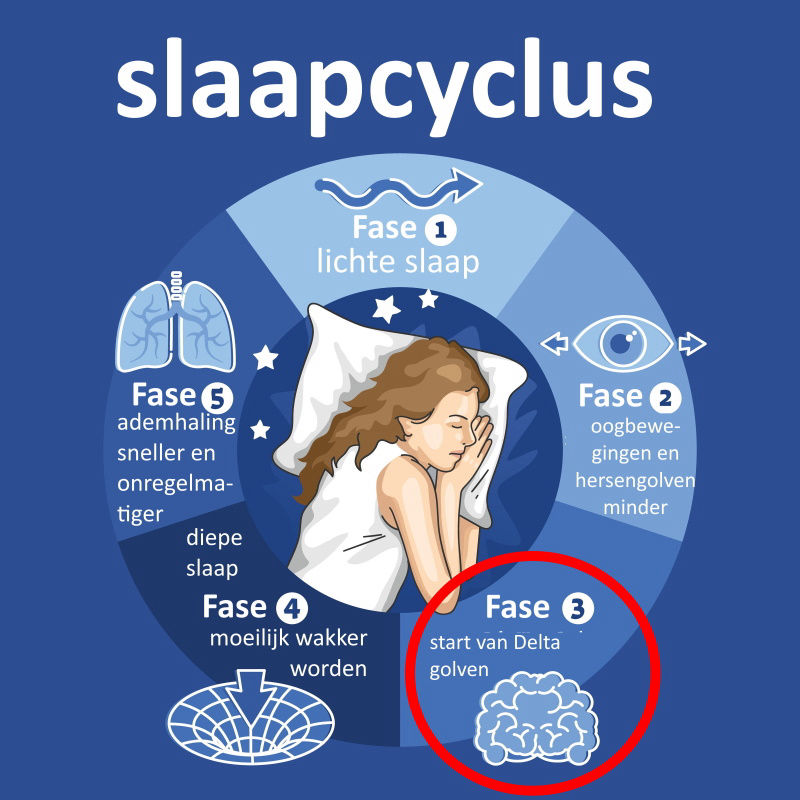
This is the preliminary phase for the phase we call “deep sleep”. This transition phase lasts only a few minutes. On the EEG, we now see slow waves referred to by the specialist as Delta waves. It's just a bit of trivia, of course, as nobody has an EEG machine to see those waves every night. In that sense, today's smartphone seems like a pretty significant asset for gaining some insight into your sleep pattern nonetheless. The specialist will always stick to what you can see on the EEG because sleep phases are defined that way.
We have already warned that the smartphone is completely unable to detect the stages in the way an EEG can. However, your smartphone does give you feedback, and you can compare nights of good sleep with those of poor sleep. We therefore certainly do not discourage its use.
Phase 4
Fast asleep
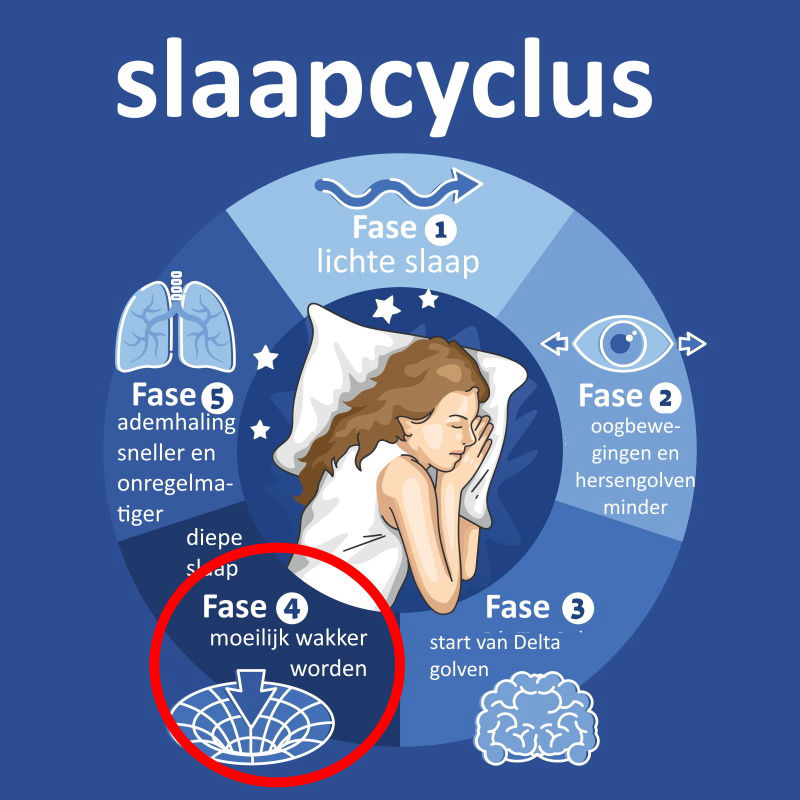
This is the period during which you enter deep sleep. You are therefore difficult to wake up, and if you are woken up, you feel confused and need time to realise where you are. This phase lasts just under 20 minutes.
This sleep stage is also still part of non-rapid eye movement (NREM) sleep. It is the second-to-last sleep stage that occurs during a typical night's sleep.
During this phase the muscles relax even more. Deep sleep is also known as slow-wave sleep because the EEG now shows many slow Delta waves.
It is during this sleep stage that
– body tissues are repaired,
– the immune system is strengthened
– and (certainly during youth) bone and muscle tissues continue to be built up. Deep sleep is also important for the proper functioning of your memory and, more generally, for the proper functioning of your brain.
Phase 5
Dreams are deceitful
The fifth sleep stage, also known as REM sleep (Rapid Eye Movements), is a striking sleep stage characterised by
– rapid eye movements (rapid eye movements);
– increased brain activity and
– an increased tension in the muscles (muscle tone).
It is the final sleep stage that occurs during the cycle.
The brainwaves measured during this phase resemble the brain activity when you are awake. REM sleep is also associated with an increased heart rate and blood pressure, as well as an increased breathing rate and body temperature.
REM sleep
Another name for this phase is: REM sleep. It is the phase in which we experience all sorts of dreams. During such a dream we experience a world that is not actually real. On the other hand, we can remember dreams that can be clearly linked to what we have experienced. It is known that people think they have not dreamt, because a dream is also quickly forgotten during that phase.
We are now showing a recording of REM sleep for illustrative purposes.
Why is this important?
REM sleep is important for several reasons. It is thought that this phase plays a major role in retaining memories and processing all kinds of emotions.
Rapid eye movements
The following comment is made on this YouTube video: In 1953, Professor Nathaniel Kleitman and his student Eugene Aserinsky defined rapid eye movements and linked them to dreaming. It is a common method for compiling dream reports by waking sleeping people up during this REM phase and questioning them; 80% of neurotypical people can provide some form of a dream report under these circumstances. People who have been woken up from REM sleep tend to give longer, more narrative descriptions of the dreams they have experienced. Lucid dreams (dreams in which the distinction between reality and fiction disappears) are reported much more frequently during REM sleep.
Once again, the sleep stages and what happens as you get older
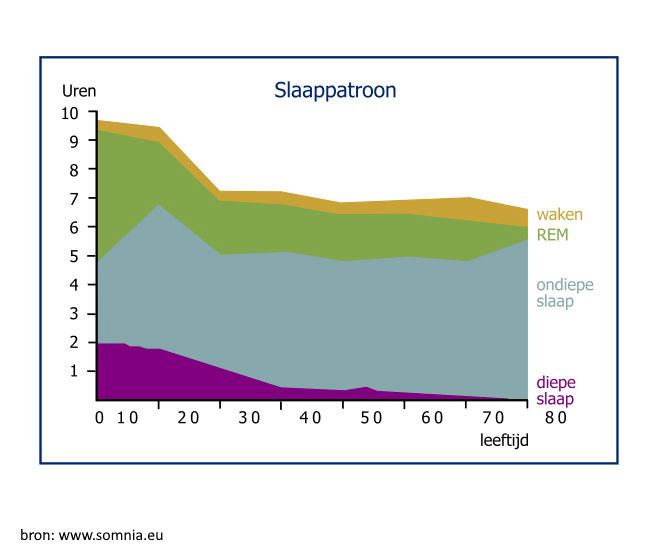
We have mentioned it before: as you get older, your
– the number of sleep cycles decreases;
– you will wake up more often;
– you will sleep less deeply.
In short, your sleep will change. That is a natural process, just as natural as your hair going grey and your mobility declining.
In the picture you can see that the duration of sleep on average does not decrease (it stays around 7 hours), but the quality clearly decreases. Deep sleep decreases almost entirely and REM sleep also decreases. Light sleep, on the other hand, clearly increases.
In the following video, sleep therapist Linda Bronts talks about what a normal sleep pattern is and which sleep pattern suits each stage of life. You will also be introduced to the concept of core sleep: the first 3 sleep cycles in the first 4 to 4.5 hours of sleep are referred to as core sleep. The majority of deep sleep and a significant part of dream sleep takes place during this period. That is therefore the most important sleep time for physical and emotional recovery.

Answer first and only then click on the question to see what our answer is
Question 1: What does the abbreviation EEG stand for?
Answer: Electroencephalogram.
Question 2: Which sleep phase is also known as the doze?
Answer: Phase 1 (also known as non-rapid eye movement sleep).
Question 3: Which substance in our brain is activated by darkness to help us fall asleep better?
Answer: Melatonin.
Question 4: What is the period of the first 3 sleep cycles (approximately the first 4 to 4.5 hours of sleep) called?
Answer: Core sleep.
Question 5: Which two scientists discovered and defined rapid eye movement (REM) in relation to dreaming in 1953?
Answer: Professor Nathaniel Kleitman and his student Eugene Aserinsky.