Can old cells become younger again?
A quick warning beforehand.
To follow this part easily, it is recommended to first read the section "DNA, the epigenome and your healthspan".
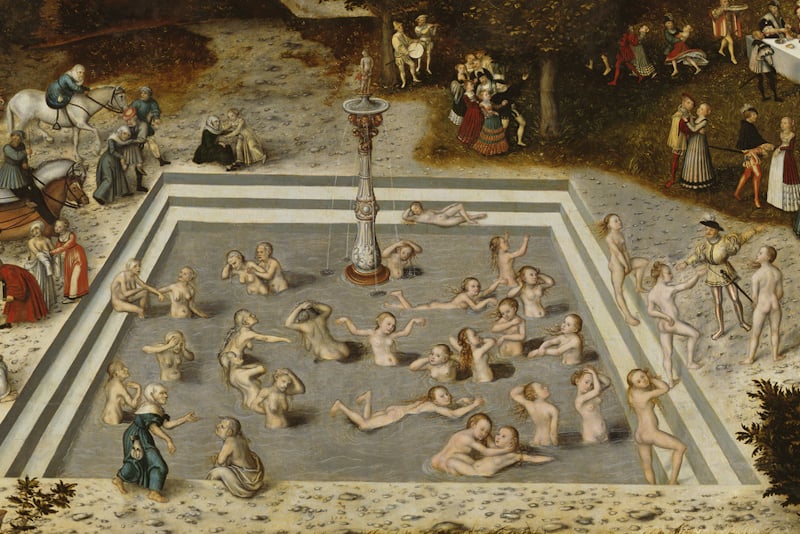
detail of “The Fountain of Youth” by Lucas Cranach (1546)
The most exciting part
This part is perhaps the most spectacular part of this series, as it directly addresses the question of whether rejuvenation is possible. For centuries, that idea has fascinated people, as can be seen in the famous painting The Fountain of Youth by Lucas Cranach.
For a long time, however, the idea of rejuvenation was dismissed as pure fantasy: impossible and unfeasible. Yet recent scientific developments seem to paint a different picture. The well-known researcher David Sinclair even argues that ageing is in fact a disease and should therefore be treated as such.
In this section we explore the remarkable results of that research.
Cells and particularly stem cells play a major role
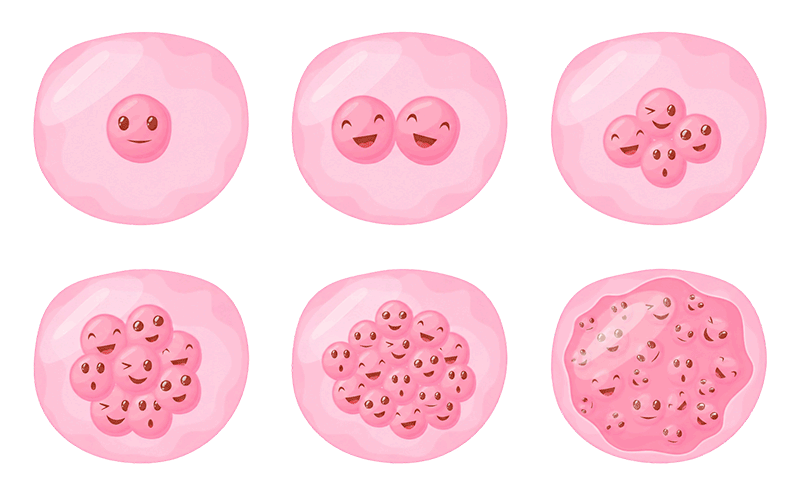
Here you can see the first cell divisions.
From stem cell to skin cell
When you were still an embryo, your body consisted of stem cells.
Those are special cells that can develop into virtually any type of cell in the body.
During development, these cells specialise step by step. Some become muscle cells, others nerve cells, skin cells or liver cells. Between a stem cell and a fully specialised cell lie various intermediate stages.
So a skin cell does not arise directly from a stem cell. First, less specialised progenitor cells are created, which gradually develop further into that skin cell. You can view these intermediate stages as earlier phases in the development of the final cell.
For a long time, scientists thought this was a one-way street. Once a cell had specialised, it could no longer return to an earlier state. A skin cell remained a skin cell and a nerve cell remained a nerve cell.
At least, that is what we thought.
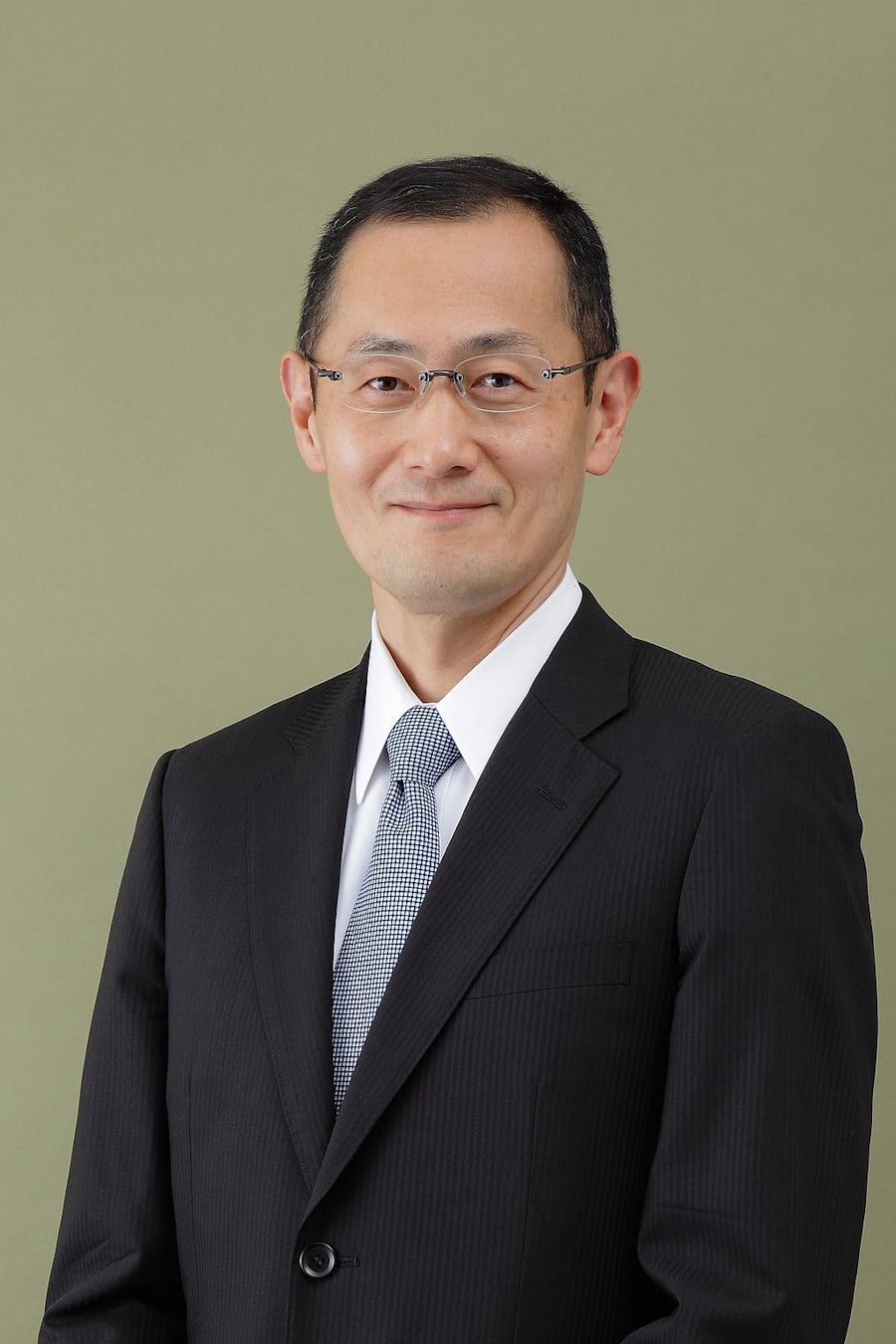
Shinya Yamanaka (source: Wikipedia)
A remarkable discovery
The discovery of the so-called Yamanaka factors showed that the existing view is incorrect. Under certain circumstances, adult cells can be reverted to a much younger, less specialised state.
That insight radically changed our view of ageing and cell development.
In 2006, the Japanese researcher Shinya Yamanaka discovered that four specific genes play an important role in the reprogramming back to a younger cell. We refer to these as the 4 Yamanaka factors.
These genes contain the blueprint instructions for proteins that act as a kind of master switch. They determine which other genes in a cell are active and which are not.
The four genes are:
• Oct4
• Sox2
• Klf4
• c-Myc
Together, the proteins produced by these genes are called the Yamanaka factors.
For most people, these names are not all that important. Much more important is what these main switches do. When they become active, can they, as it were, revert an adult cell to a much younger state. The cell loses some of its specialisation and regains properties of a stem cell.
You can compare it to a computer being restored to its factory settings. The original information remains present, but the system reverts to an earlier state and can be set up again.
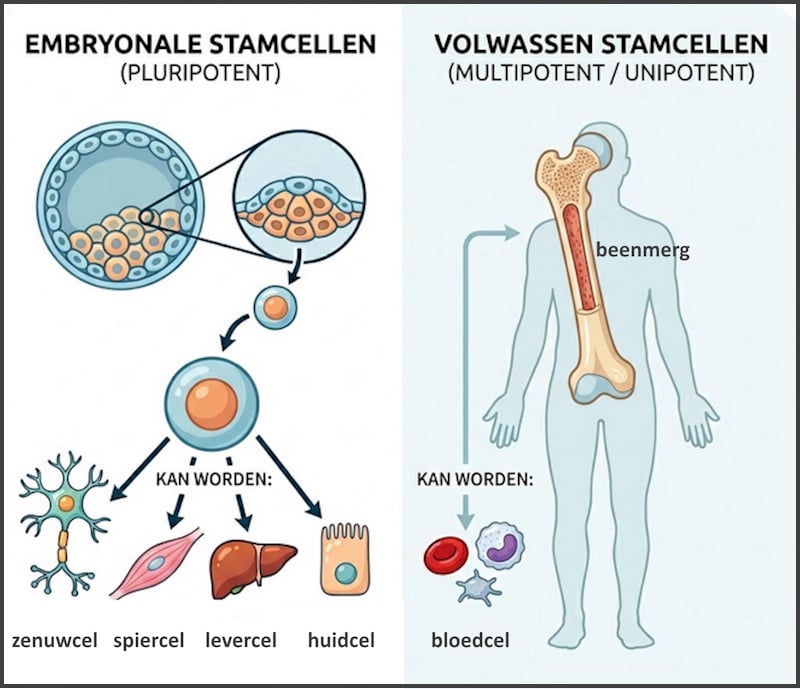
embryonic stem cells and adult stem cells The arrow on the left suggests that a single isolated stem cell divides directly into either a nerve cell, a muscle cell, or a liver cell. In reality, this is a complex process with many intermediate steps (progenitor cells) in which the cell becomes progressively more specific.
Two types of stem cells
Is it theoretically possible to achieve complete biological rejuvenation? To answer that question, we first need to look at stem cells. They form the basis of the development, maintenance and repair of our body.
Embryonic and adult stem cells
Embryonic stem cells are pluripotent. That means that they are not yet specialised and can develop into virtually any type of cell in the body.
Adult stem cells are more limited. They are found in the bone marrow, skin and liver, among other places. Their main task is to replace and repair damaged cells. Usually, they can only develop into a limited number of related cell types.

film trilogy
Can a cell go back in time?
For a long time, scientists thought that a specialised cell had locked in its identity for good. A skin cell remained a skin cell and a muscle cell remained a muscle cell.
However, research over the past twenty years has shown that cells are much more flexible than previously thought. Using Yamanaka factors, scientists can partially reprogram a mature cell back to a younger, less specialised state.
The DNA does not change in the process. What does change is the way the cell uses its genetic information. The cell is, as it were, reset to an earlier stage of its development.
This insight forms the basis of much modern research into rejuvenation and regenerative medicine.
The following video gives a nice overview.
We also provide a summary in which certain terms are explained.
The video “How To Make Stem Cells | Yamanaka Factors” by the channel Sciencerely explains how the Japanese scientist Shinya Yamanaka discovered a method to turn ordinary cells (such as skin cells) into stem cells [00:53]. This discovery earned him the Nobel Prize in 2012 [01:15]. Here is an overview of the key points from that video. The indicated timestamps are moments on the video's timeline.
What are stem cells, which types do we know and why are they important?
Answer:
PropertiesStem cells can self-renew and have the ability to transform into specialised cells (such as muscle or nerve cells). This process is called differentiation [01:51]. We have already provided the necessary text and explanation for this in the preceding sections.
Embryonic versus adult stem cellsEmbryonic stem cells are pluripotent: they can still all (hence the name pluri) body cell types [02:26]. Adult stem cells (such as those in your bone marrow or liver) are more limited and are called multipotent or unipotent [02:36]. Multipotent means that they can develop into a number of cells and unipotent means that they can grow into one specific cell type.
The ethical advantageThanks to Yamanaka’s discovery, scientists can now create pluripotent stem cells themselves from adult tissue, meaning the sacrifice of embryos for research is no longer necessary [01:06].
The discovery of the Yamanaka factors
Stem cells owe their unique properties to specific genes that are ‘switched off’ in normal, adult cells [04:17]. Yamanaka wanted to know whether he could force adult cells to become stem cells again by activating these specific genes [04:51].
In 2006, he selected 24 candidate genes [06:00]. By infecting cells with various combinations of these, he discovered that only 4 specific genes are needed to reprogram a skin cell (fibroblast) into a stem cell [05:04, 06:36]. These genes are called the Yamanaka factors:
3/4 Oct
Sox2
Klf4
c-Myc
The stem cells made in this way are called induced pluripotent stem cells (iPS cells) [05:25].
Applications and the major risk
InfectionIn the future, iPS cells could be used to grow organs or tissues for transplantation [07:06]. Because these cells can be made from the patient's own body, the risk of rejection by the immune system is minimal [07:22].
The risk (cancer)Stem cells and cancer cells are very similar because they both divide rapidly [07:51]. In fact, one of the Yamanaka factors (c-Myc) is a well-known gene that can cause cancer [08:03]. In addition, the original experiment used viruses to insert the genes, which can permanently damage the DNA [08:18]. Scientists are therefore looking for safer methods (such as using RNA) [08:32].
First successful results
Despite the risks, the first clinical trial on a human was carried out in 2014 [08:37]. iPS cells from a patient with macular degeneration (an eye condition that leads to blindness) were transformed into retinal cells and transplanted back into the eye [08:42]. This treatment was successful: the deterioration of vision stopped and even improved [08:58]. Research is currently also underway for the treatment of heart conditions, diabetes and spinal cord injuries, among other things [09:03].
Four points to then ponder

1. Why is this so interesting?
The discovery of the Yamanaka factors was so important because it showed for the first time that cell ageing and specialisation are also irreversible.
Until that moment, many scientists assumed that a cell could only develop in one direction: from stem cell to specialised cell. A skin cell remained a skin cell and an old cell remained an old cell.
Yamanaka showed that this was incorrect. By activating just four genes, an adult skin cell could be reverted to a state that closely resembles that of an embryonic stem cell. This meant that the cell could, as it were, erase part of its “biological history”.
That insight has major implications for ageing research.
As we grow older, not only do our organs change, but our cells do too. Their epigenome gradually becomes dysregulated. Genes that should be active become less active and other genes more so. Scientists sometimes speak of a loss of cellular identity.

2. Without a full reset?
The Yamanaka factors show that these changes are not necessarily permanent. If a cell can be reverted to a younger state, the question naturally arises:
Can we also rejuvenate senescent cells without reverting them entirely back to a stem cell?
That is precisely what a large part of current longevity research focuses on.
The problem is that complete reprogramming carries risks. A skin cell that becomes a stem cell again loses its function. Furthermore, uncontrolled growth can lead to tumours.

3. Partial reprogramming
Therefore, scientists nowadays are mainly investigating partial reprogramming. In this process, the Yamanaka factors are activated only briefly or partially. The goal is not to turn a skin cell back into a stem cell, but to roll back the biological age of the cell while it retains its function.
With laboratory animals, remarkable results have already been achieved. Researchers saw improvements in:
repair of damaged tissue;
muscle function;
nerve function;
eyesight;
epigenetic age.

4. A different vision on ageing
We are seeing a new perspective on ageing emerge:
If a cell can become younger without losing its identity, then ageing might not only be an inevitable process, but also one that can be partially reversed.
That is the reason why Yamanaka's discovery is often seen as one of the most important breakthroughs in modern longevity science. It provided the first experimental evidence that biological age can potentially be influenced. Not because we change the DNA, but because we can reset the way the cell uses that DNA.
If that approach can ever be safely applied in humans, it might also contribute to a longer life (increasing the lifespan). Therefore, partial reprogramming is nowadays among the most researched topics within longevity science.

Questions or assignments
In this course you will sometimes come across questions or assignments. Above all, do not be put off by them! You are under no obligation whatsoever, after all. They are purely intended as extra depth for anyone who fancies it. So please feel free to just skip them.