
The future has begun
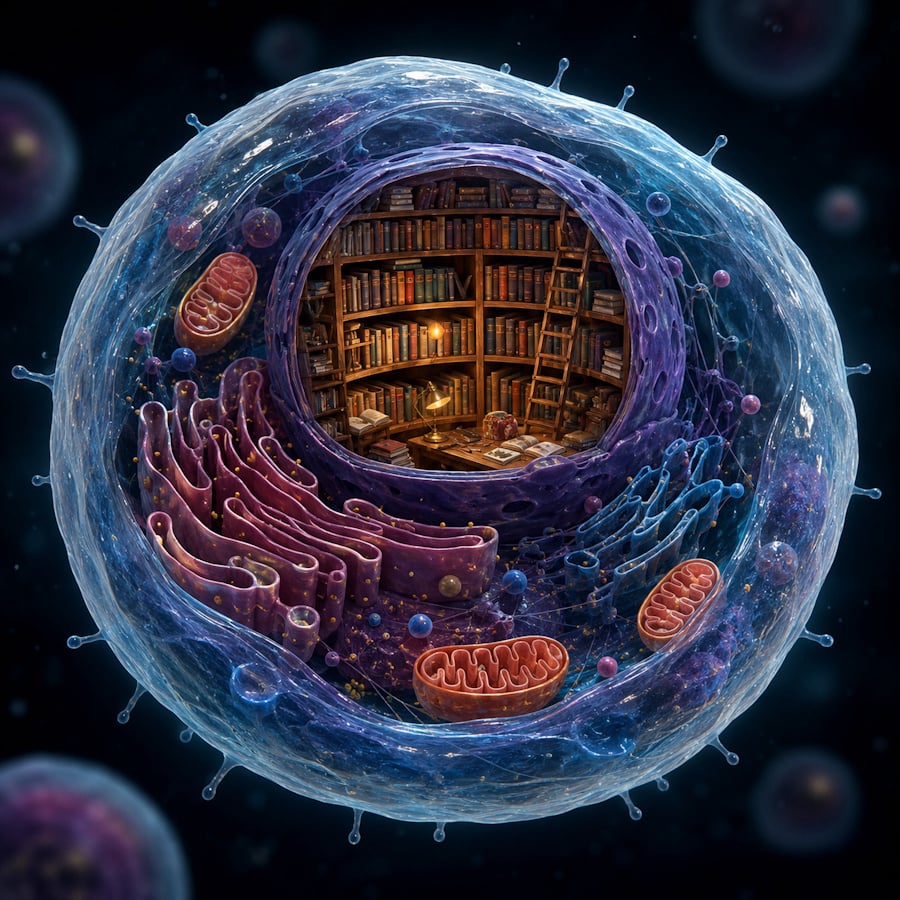
Why was Yamanaka’s discovery such an important discovery?
Yamanaka's discovery was revolutionary because it showed that an adult cell is much more flexible than scientists had long thought possible.
A skin cell contains the same DNA as a muscle cell or a nerve cell. That was, of course, already known. However, it was assumed that a specialised cell [its] identity definitely recorded.
Yamanaka showed that this is not the case. By activating four special genes, an adult cell can be reverted to a much younger state.
That insight has far-reaching consequences.
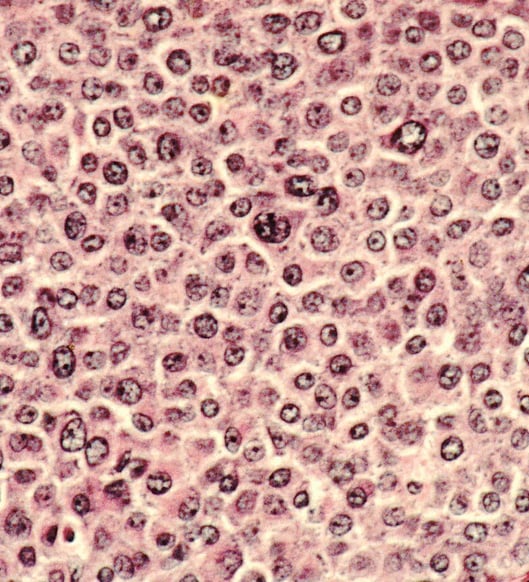
Cancer cells (source: Wikipedia)
The problem: too much of a good thing
However, there was a major problem with this discovery.
When the Yamanaka factors remain active for a prolonged period, a mature cell eventually turns back into a stem cell.
That sounds appealing, but usually that isn't what you want.
After all, a muscle cell needs to remain a muscle cell.
A nerve cell must remain a nerve cell.
A liver cell must remain a liver cell.
One full reprogramming makes a cell younger, but also causes it to lose its identity.
Moreover, a second risk also arises. Stem cells can divide very rapidly. When that process is not properly controlled, unchecked growth can occur. And precisely that is one of the characteristics of cancer.
The big challenge for researchers is therefore: can we actually make a cell younger without it losing its identity?
Here is another brief recap regarding DNA and the epigenome to make everything even clearer.
Do genes change?
No.
That is an important point.
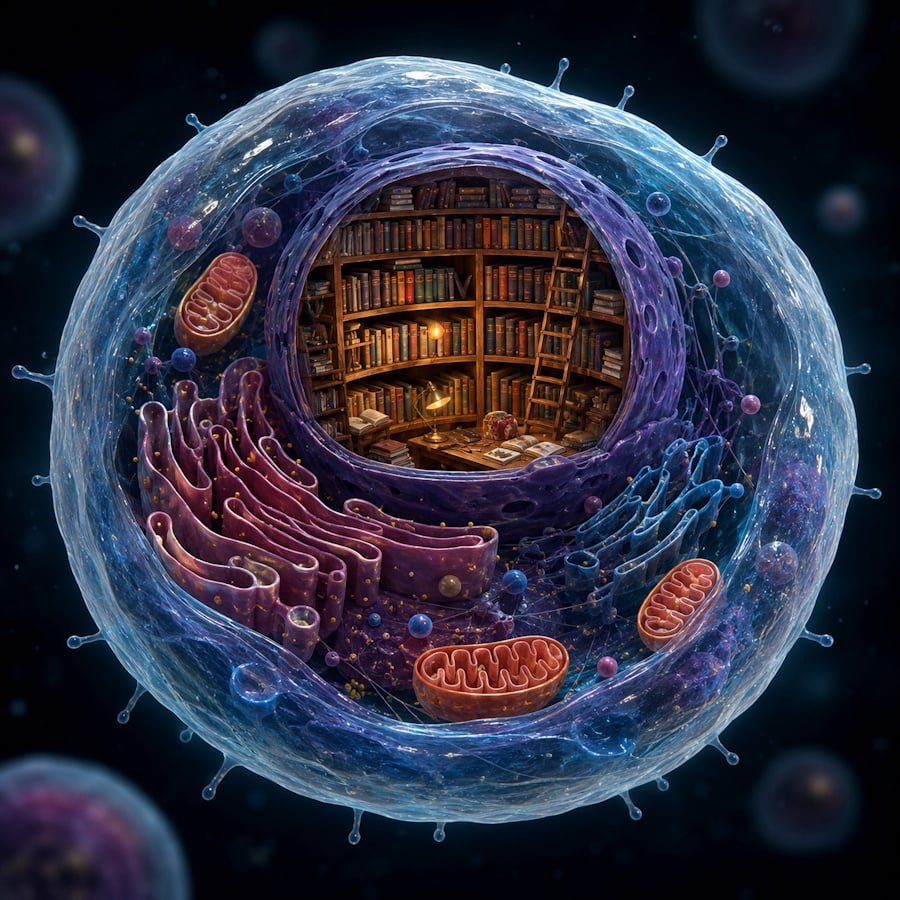
The Yamanaka factors do not change the DNA itself. The genetic code remains the same. What changes is the way the cell uses that code.
You can compare it to a bookcase. The books stay exactly the same. Only the way they are arranged changes. As a result, different information becomes accessible.
A skin cell, a muscle cell and a nerve cell essentially contain the same DNA. Yet they behave very differently. That is because every cell uses a different selection of genes.
The question is then: what determines which parts of the DNA are used and which are not? To answer that, we have to look at a second system within the cell: the epigenome.
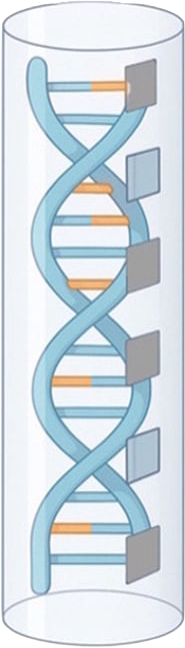
a representation of the epigenome as a casing with little shutters
The epigenome plays the starring role
In the first parts of this series, we saw that the epigenome determines which genes are active and which are not.
You can view the epigenome as a conductor that determines which instruments play in an orchestra.
In a young cell, this regulation usually proceeds very precisely.
As we age, that regulation becomes less and less precise.
The patterns that determine which genes are switched on or off change gradually. As a result, an old cell begins to behave differently from a young cell.
This is where the Yamanaka factors come in. These four factors can intervene in the epigenome. They change which genes are active and which are not. As a result, an adult cell regains characteristics of a much younger cell.
You could say that the Yamanaka factors give the conductor a new score. As a result, the cell no longer follows the programme of an old cell, but increasingly the programme of a young cell.
Precisely why the Yamanaka factors are so important. They show that the epigenome is not fixed, but can be reset under certain circumstances. One of the scientists building on this is David Sinclair.
Many scientists indicate that wear and tear of the epigenome (for whatever reason) is the primary cause of ageing.
Repairing that damage therefore entails rejuvenation.
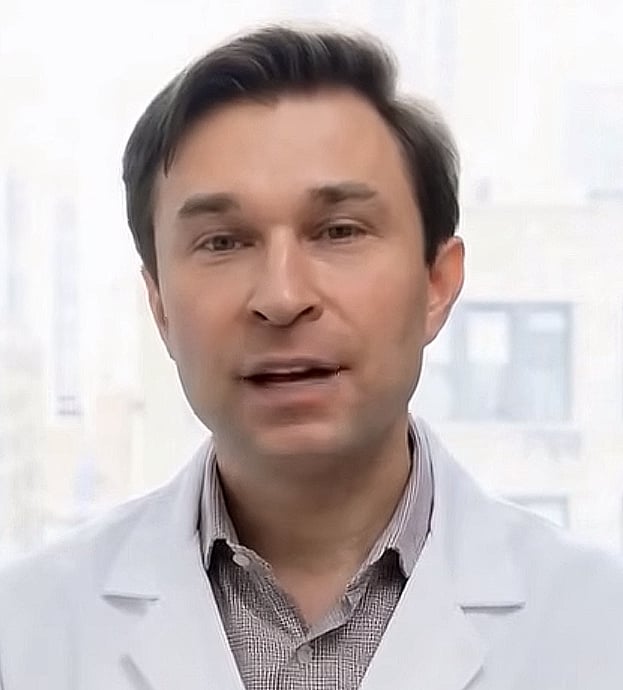
David Sinclair
The information theory of ageing
David Sinclair is definitely one of the best-known researchers in this field. According to him, ageing is caused not only by damage to cells, but also by the epigenome gradually losing information. The cell becomes less and less able to tell which genes should be active and when.
Sinclair sometimes compares this to a CD. The music is still on the CD, but the player is no longer reading the information perfectly.
As a result, the music sounds less good.
According to Sinclair, something similar happens in ageing cells.
We are showing one of the many videos in which Sinclair explains this concept.
Is Ageing Reversible?
A Scientific Look with David Sinclair | TEDxBoston
This TEDx talk by Dr David Sinclair (Harvard Medical School) is about the revolutionary shift in ageing science and the possibility of reversing biological ageing.
Here is a structured summary of the key insights from the video:
1. A new vision on ageing
Ageing as a medical condition: Sinclair argues that ageing is the underlying cause of 90% of all diseases and suffering in the world. Instead of accepting it as a ‘natural’ process, it must be treated as a medical condition.
Life expectancy: He predicts that the first human to live to be 150 years old has already been born and that future technologies will go beyond our current imagination.
2. The Information Theory of ageing, relationship with the epigenome and biological clock
Replacement of old theories: The old theory that antioxidants and free radicals play the main role in ageing is outdated.
The epigenome as the ‘CD player’: Sinclair introduces the Information Theory of Ageing. DNA (the genetic code) is digital information, comparable to a compact disc (CD). The epigenome is the analogue ‘reader’ that determines which genes are switched on or off in specific cells. Ageing is caused by “scratches on the CD”, causing cells to lose their identity and function.
DNA methylation (The Horvath clock): Chemical tags (methyl groups) on DNA change according to a predictable pattern. Algorithms can use this to measure exact biological age instead of chronological age.
3. The built-in defence mechanisms
The body has three main routes to defend itself against ageing, which respond to mild stress and scarcity (adversity). We give only the names and the effects:
mTOR: Responds to fasting.
AMPK: Responds to low energy and blood sugar levels.
Sirtuins (SIRT): A group of genes/proteins (Silent Information Regulators) that protect and repair the epigenome. They are activated by fasting, exercise and specific molecules.
4: Scientific breakthroughs in the lab and the relationship with the Yamanaka factors?
Accelerating and reversing ageingBy deliberately scratching the epigenome of mice, his team managed to make genetically identical twin mice age 50% faster.
NAD+ boosters: The administration of molecules such as NMN (a fuel for sirtuins) already resulted in the rejuvenation of the cardiovascular system in old mice in 2018.
Yamanaka factors and cellular reprogrammingInspired by the work of Shinya Yamanaka, Sinclair's lab has used a subset of three embryonic genes (Oct4, Sox2, Klf4 — abbreviated as OSK) to rejuvenate cells without them losing their identity or becoming tumours.
Successful experiments: With this OSK gene therapy, they repaired damaged and ageing optic nerves in mice, allowing them to regrow and restoring vision. In addition, they are testing this on human ‘mini-brains’ (organoids) in the lab, with electrical activity returning after rejuvenation. In old mice, this caused their learning ability to be restored.
5: Conclusions
We are at the beginning of a biological revolution in which we can not only slow down ageing, but actually reset the biological clock. Sinclair concludes with the message that the 22nd century will be entirely dedicated to mastering our biology and the rate at which we age.
Dr David Sinclair is surely the best-known person when it comes to longevity. His assertion that ageing can be regarded as a disease also invites considerable criticism. That does not alter the fact that what has been scientifically discovered is spectacular. What does the principal criticism from scientific circles consist of?

Ageing is not a disease
Sinclair argues that ageing should be treated as a disease. Many gerontologists disagree.
Hun argument
A disease is a deviation from normal functioning.
Ageing is a universal biological process that everyone goes through.
By calling ageing a disease, the distinction between normal life processes and disease is blurred.
Others, however, feel that this definition issue is of little relevance. If you can slow down ageing, the name matters less.

Results in mice are not results in humans
A large part of the spectacular findings comes from animal research.
Examples:
– lifespan extension in mice;
– improvement of muscle function;
– restoration of vision;
– epigenetic rejuvenation.
Critics point out that:
- mice are not humans;
– countless treatments that work in mice ultimately fail in humans;
– many longevity interventions have not yet been convincingly clinically proven.
This is probably the most frequently heard scientific criticism.

What virtually everyone does agree on
Remarkably, there is much less discussion nowadays about several core issues that were still controversial twenty years ago.
Virtually all researchers now recognise that:
– biological age is measurable;
– the epigenome plays an important role;
– lifestyle influences the rate of ageing;
– ageing processes are biologically modifiable;
– some aspects of ageing in animal models appear to be partially reversible.
So the real discussion is not about whether ageing is influenceable, but about:
– how much influence we truly have;
– how strong those effects are;
– when this is convincingly demonstrated to people.
Right there, Sinclair is often found on the optimistic side of the spectrum, while many other gerontologists phrase things more cautiously. That explains why he is at once so influential and so controversial within the longevity world.

Answer first and only then click on the question to see what our answer is
Question 1: According to David Sinclair, what is the main cause of many diseases?
Answer: According to Sinclair, ageing is the underlying cause of about 90% of all diseases. Therefore, he believes that ageing should be treated as a medical condition.
Question 2: What does Sinclair mean by the Information Theory of Ageing?
Answer: According to this theory, the DNA remains largely intact, but the epigenome becomes dysregulated. As a result, cells lose their identity and function less effectively, which leads to ageing.
Question 3: Which three major defence systems against ageing does Sinclair mention?
Answer: The three main systems are:
mTOR
AMPK
Sirtuins (SIRT)
Question 4: What are the Yamanaka factors and what did Sinclair's team use them for?
Answer: The Yamanaka factors are genes that can reset cells to a younger state. Sinclair's team used three of these factors (OSK: Oct4, Sox2 and Klf4) to rejuvenate aged cells without them losing their identity.
Question 5: What is the main scientific criticism of Sinclair's work?
Answer: The main criticism is that many spectacular results have been achieved in mice. Critics point out that mice are not humans and that many treatments that work in mice ultimately prove unsuccessful in humans. Therefore, more clinical research is needed.