Science today for a healthier tomorrow
Many people think of stress primarily as being busy at work.
However, research shows that it is not so much the amount of work that is the biggest problem, but the lack of recovery. Our bodies are made to alternate periods of exertion with periods of rest. When that alternation disappears, a situation arises in which stress slowly builds up.
A good work-life balance is therefore not just about the number of hours someone works. It is primarily about whether there are sufficient moments when the body and mind can recover.
Within the longevity field, this subject is receiving increasing attention. We now know that prolonged stress affects the epigenome: the system that determines which genes are active and which are not. Researchers are increasingly observing that people with chronic stress have, on average, a higher biological age than people with sufficient periods of recovery.
During periods of tension, the body produces various stress hormones, including the aforementioned adrenaline and cortisol. These hormones help us to react alertly to challenges. That is useful when we have to give an important presentation, solve a problem or act quickly in an emergency situation.
However, following that exertion, the body should return to a state of rest.
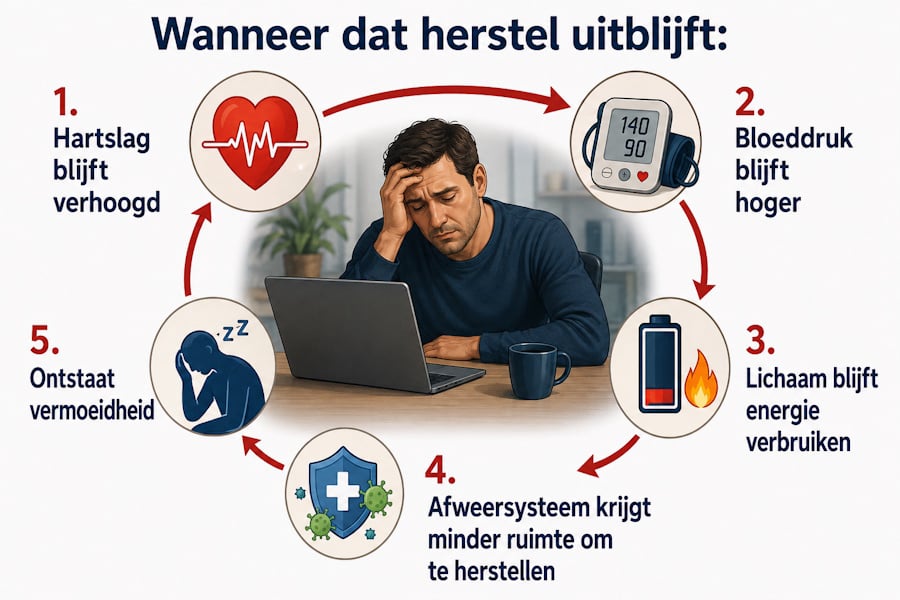
When that recovery fails to happen:
• does the heart rate remain elevated;
• does the blood pressure remain higher;
• the body continues to consume energy;
• the immune system has less room to recover;
• fatigue occurs.
A human can endure a great deal of stress, provided there is sufficient recovery to balance it.
In the past, the boundary between work and personal life was often clearer.
At the end of the working day people went home and work was left behind in the office.
Because of smartphones, email, Teams, WhatsApp and other means of communication, that boundary has become less clear.
Many staff:
• read emails in the evening;
• answering messages at the weekend;
• thinking about work during holidays;
• experience the pressure to always be reachable.
This gives the body fewer opportunities to come to complete rest. The result is that tension does not disappear, but remains present in the background.
Sleep is perhaps the most important recovery activity we have.
During sleep:
• repairs the brain;
• memories are processed;
• damaged cells are repaired;
• the immune system gets the chance to recover.
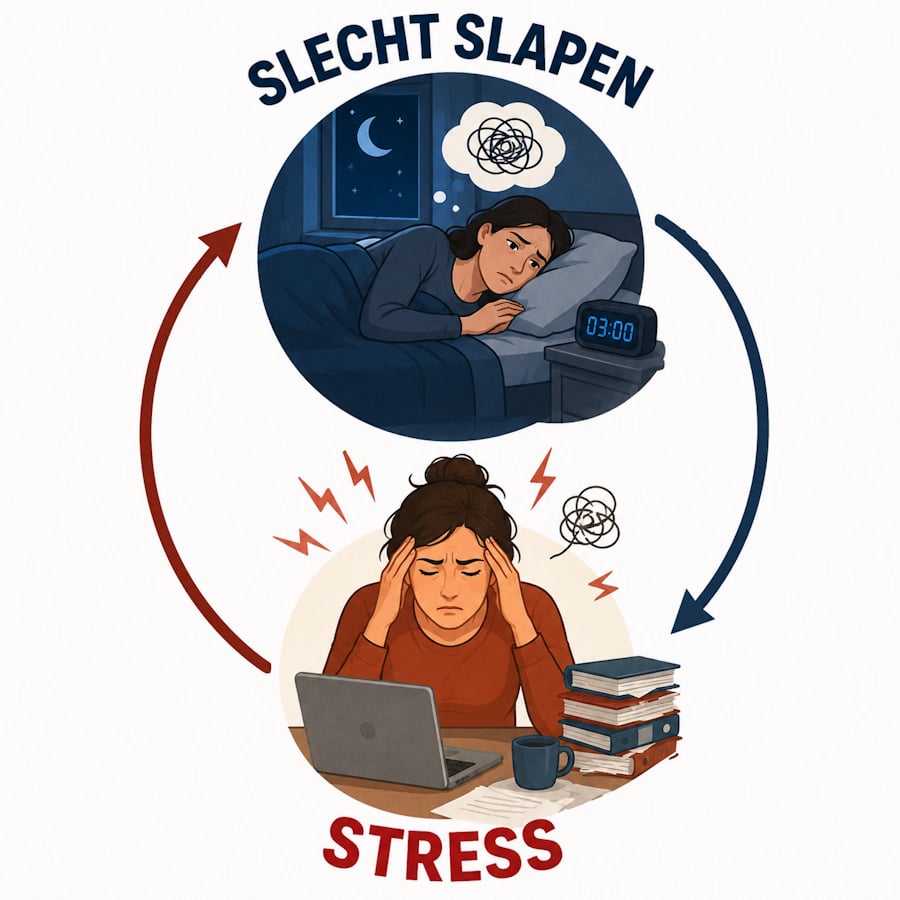
Chronic stress and poor sleep reinforce each other. Stress leads to poorer sleep. Poorer sleep makes people more sensitive to stress.
Thus, the aforementioned vicious circle is easily created. Within longevity, sleep is therefore regarded as one of the most important factors for healthy ageing.
We have also created a separate section for this topic.
People are social creatures. Research shows that social support is an important protective factor against long-term stress.
This may involve:
• a partner;
• family;
• friends;
• colleagues;
• a manager.
People who are able to discuss problems with others turn out, on average, to be more resilient to stress than people who try to solve everything on their own.
A good conversation does not always solve the problem, but it often reduces the perceived burden.

Movement is sometimes seen as an extra burden. Yet, regular exercise actually works to reduce stress.
During movement:
• voltage drops;
• improves the mood;
• sleep quality increases;
• improves fitness;
• helps the body recover faster.
That does not require extreme performance.
Walking, cycling or gardening every day can already have a noticeable effect.
When organisations look at work-related stress, they often focus on the work itself. Yet personal circumstances also play an important role. Consider:
• informal care;
• financial worries;
• relationship problems;
• illness within the family;
• child upbringing.
For employees, the combination of work pressure and personal commitments can weigh heavily.
Therefore, it is important that managers have an eye for the person behind the role.
A healthy work-life balance also requires personal choices.
Many people struggle with:
• saying no;
• delegating tasks;
• prioritising;
• to adjust expectations.
As a result, they take on more responsibility than is necessary.
Setting boundaries is not a sign of weakness. Rather, it is a way to remain healthy and employable in the long term.
What does this mean for me?
A good work-life balance does not mean that work is unimportant. It means that effort and recovery remain in balance with each other.
Ask yourself regularly:
• Do I have enough moments of relaxation?
• Am I getting enough sleep?
• Can I switch off from work?
• Do I have time for family, friends and hobbies?
• Do I regularly feel rested?
When the answer to several of these questions is “no”, that can be a sign that the balance is under pressure.
Even small changes can make a big difference. Getting enough sleep, regular exercise, social contact and clear boundaries not only help to reduce stress, but also contribute to a healthier, more vital and potentially longer life.
Answer: The body is designed for a combination of exertion and rest. During recovery, heart rate, blood pressure and stress hormones can drop again. Without sufficient recovery, stress builds up and the risk of health problems increases.
Answer: Because of smartphones, email, Teams and WhatsApp, many people remain accessible outside working hours. As a result, they think about their work more often and the body gets less of a chance to fully relax.
Answer: During sleep the brain recovers, memories are processed, damaged cells are given the chance to repair and the immune system can strengthen itself. That is why sleep plays an important role in health and longevity.
Answer: Social support from a partner, family, friends, colleagues or a manager helps people cope better with stress. Discussing problems often reduces the perceived burden and makes people more resilient against long-term stress.
Answer: Examples include informal care, financial worries, relationship problems, illness within the family and raising children. These factors, combined with work pressure, can result in a heavy burden.