Science today for a healthier tomorrow
Lucas Cranach, The Fountain of Youth (c. 1546)
The above painting depicts the fountain of eternal life. Until now that seems innocent, but once we know that Cupid is standing on the pillar in the middle, that could already be a warning.
We see a bath where old women step in on the left and emerge as virgins on the right.
A little thought brings us rather quickly to the first problem: at what age should you be eternally young? Not as a baby, of course, because staying a baby forever cannot possibly be a wish. And what about 40 years old, for example? Well no, poor choice. After all, when you are 40 you are already starting to look clearly older.
Ultimately, we see how the young virgins step out of the bath, are offered a magnificent meal and are afterwards dragged into the bushes (see image top right). Me too in the distant past!
Even before the creation of “The Fountain of Youth”, people were already dreaming of a longer life, or even better, of eternal life. In ancient stories and myths, the same images keep recurring. Think of the search for a spring that keeps you young, an elixir that prolongs your life, or a secret reserved for only a small group.
– In the tales from ancient Mesopotamia, the hero Gilgamesh searches for immortality.
– In China, emperors searched for the “elixir of life”.
– In Europe, people dreamed of the “fountain of eternal youth”.
They are different cultures, different times — but every time the same wish.
In the Middle Ages and early Renaissance, alchemists in both Europe and Asia had only two main goals:
– the making of gold
– finding a means to eternal life (the elixir of life)
One of the best-known names in this regard is Nicolas Flamel. According to legend, he discovered the Philosopher's Stone — a mysterious substance that could not only turn metals into gold, but also produce an elixir that granted immortality.
It is even said that he and his wife, Perenelle Flamel, faked their deaths and continued to live in secret.
The person Flamel has mainly gained fame through the six-part book series “The Secrets of the Immortal Nicholas Flamel” by the Irish author Michael Scott.
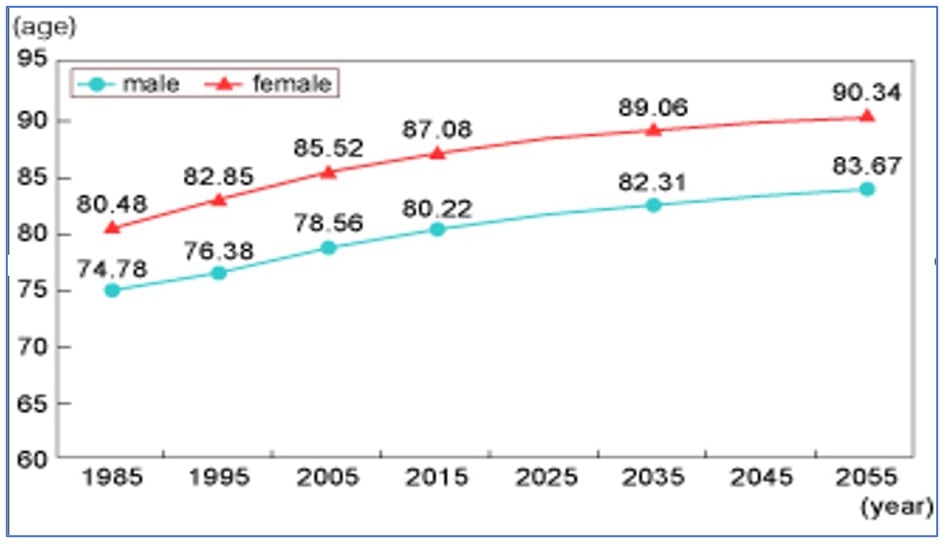
Here we see an image of the increase in life expectancy in Japan. The figures in the Netherlands are approx. 4 years lower. People live the longest in Japan.
Calculations by Statistics Netherlands (CBS) (for the period up to 2005) show that the average life expectancy for boys had increased by nearly 3 years over a 15-year period. That will be less now.
In Rudi Westendorp's classic book “Oud worden zonder het te zijn” (Growing old without being old), not a single reference to Yamanaka's discoveries is included. In the aforementioned book, this well-known professor explains how our average life expectancy has increased enormously over recent decades. He uses various arguments for this. We mention:
knowledgewe are living longer and longer because more and more is known about what is good and bad for our health;
better facilitiesthere have been increasingly better facilities such as good clean drinking water, better housing, etc.;
medical knowledgeour medical knowledge has expanded enormously (more medicines, better surgical techniques, the use of new technologies, etc.) and that development is not standing still;
healthy livingwe know a lot more about how important exercise and certain nutrition are for our health;
self-directionwe know how important personal control is; being able to make independent decisions for a healthy lifestyle.
Building on the earlier work of John Bertrand Gurdon, Shinya Yamanaka published a simple recipe in 2006 that made it possible to revert adult cells back to the embryonic stage.
His research began when he focused on undifferentiated embryonic stem cells. These are cells that arise after fertilization of the egg cell and are capable of forming all cell types of the body. We will discuss this in detail shortly,
In 2012 (four years prior to the publication of Westendorp’s book), he would receive the Nobel Prize in Physiology or Medicine for this, together with Gurdon.
It is this discovery that underpins the marvellous exploration we are now beginning. An exploration that increasingly supports the suspicion that rejuvenation is indeed possible in humans.
What is certain is that tests on animals show that this is possible.
For humans, we are now on the verge of experiencing a revolutionary upheaval when it comes to life expectancy.
In his groundbreaking book “Lifespan, Why we age – and why we don’t have to”, Harvard researcher David Sinclair shows that ageing does not have to be an inevitable natural phenomenon, but a process that we are increasingly beginning to understand — and potentially even influence. There is no person who steps so much to the fore when it comes to longevity as David Sinclair!
In this book, he describes how the medical world has always assumed that old age is a disease. Ageing is then seen as something we can do nothing about. And then he asks: what if that premise is wrong?
What if ageing is actually a disease?
And what if that disease is not only understandable, but also treatable — perhaps even reversible?
Of course that book caused a sensation. It comes as no surprise that with such a bold statement, Sinclair also has many opponents in the medical world. That does not alter the fact that to this day he has not changed his opinion and is invited everywhere.
Here we see such a recital.
In the video “The Science of Living Longer – and Better” from the World Governments Summit (2026), Professor David Sinclair of Harvard Medical School presents a revolutionary perspective on ageing. He states that we are on the eve of the greatest medical shift in human history: the ability to control our own biology and reverse the ageing process [00:52].
The core of his argument is the “Information Theory of Ageing”. Sinclair compares the body to a computer, where ageing does not stem from physical wear and tear, but from the loss of digital information (corruption of the ‘software’). He argues that cells lose their identity over time because they can no longer read the DNA correctly [09:17]. However, by using specific genes (the so-called Yamanaka factors), his lab has succeeded in ‘rebooting’ cells to a younger state without reverting them completely to stem cells [12:04].
Experiments with mice and monkeys have shown that this method can cure blindness and repair damaged nerves [13:24]. Sinclair announces that the US FDA has recently given approval for the first clinical trials in humans, initially focusing on eye conditions such as glaucoma [15:41].
Alongside the medical breakthrough, he emphasises the enormous economic importance: slowing down ageing by just one year would yield trillions of dollars for the global economy through higher productivity and lower healthcare costs. His vision is a world in which we can spend our 80s or 90s just as vitally and productively as our 40s.
In other words, it is not the DNA itself that changes, but the way it is used. And that is precisely where the opportunities lie. For if that control changes, you can in principle influence it too. That is already happening through lifestyle (diet, exercise, stress), and increasingly through new technologies.
That is why the epigenome is at the foundation of longevity (the study of living longer and healthier): for the first time, it makes clear why we age — and what we can do about it.
David Sinclair’s insights are naturally very important to you personally, as they show that ageing does not have to be a fixed fate.
It looks like we are soon going to have a new “steering wheel” in our hands: you will be able to influence how long you live. And this approach will also have significant implications for the treatment of typical age-related diseases such as dementia and diabetes.
The idea that your biological age is influenceable is something that will interest everyone, and with the knowledge from the previous parts, it is also easy to follow what it is about.
What the book is about
This course is partly based on the book The future of ageing by emeritus professor Dr Ir Kasper Boon. This book covers recent scientific breakthroughs that are profoundly changing our thinking about ageing. The emphasis is on the role of DNA, the epigenome and other biological processes associated with ageing. The book also shows how Artificial Intelligence (AI) is helping researchers to understand these processes better and better. This is giving rise to new expectations regarding the slowing down of ageing and possibly also forms of rejuvenation.
2. The added value of this online series
Although the book provides a good basis for reading everything calmly on paper, this online series has a number of additional benefits:
Interaction
With videos and question-and-answer games, the explanation becomes livelier and more active.
Floor
For some topics, we go into more detail.
Visual aids
Using images and videos, we make complex processes within our cells transparent step by step.
We have divided the material into two parts:
(1) the epigenome in the context of understanding ageing processes
(2) how further developments are viewed