Science today for a healthier tomorrow

People usually don't change because they want something new,
but because they feel that the old ways no longer fit.

detail of “The Fountain of Youth” by Lucas Cranach (1546)

It has crept in...

For many people, habits are no longer a conscious choice. Habits have, as it were, crept in as an automatic response; they are, so to speak, “baked” into your brain. So even if someone thinks:

“I want to eat more healthily”
“I want to cut down on sweets”

the old behaviour simply carries on. Not because that person wouldn't want it to — but because it happens automatically.

To put it another way: change is not just about starting something new, but above all about unlearning something old that has become automatic. 

And unlearning that is often difficult. It generally proceeds much slower and is less visible than learning something new.

Breaking down barriers

So you cannot simply change an unhealthy habit that has existed for years. That is completely normal. Many choices that we make every day have indeed become fixed patterns over time. Precisely for this reason, it is so important to pause and consider the question: what is actually holding me back?

Anyone wanting to live more healthily often notices that it is not just a matter of knowing what is good. Many people are well aware that walking, eating more healthily, sleeping better and exercising more are important. Yet they fail to actually get started. That is usually not due to unwillingness, but rather to uncertainties and ideas that hold us back.

Why is breaking existing patterns so difficult?

To answer this question, we must first consider that it is often about what people do not do consciously. For example, on the basis of a prejudice.

Just think about prejudices such as:

“Yes, I just happen to need this to unwind”

of

“Yes, I know, but you also know that eating healthily is quite tricky.”

“You really don't have to tell me anything... I can't keep this up anyway”

Those are not facts — they are ingrained thought patterns, prejudices that result in many “protest votes”.

Brain

Behind every habit lies a drive from our brain.
In any case, you can say that you can build certain patterns in which you are supported to maintain a certain behaviour. In a way, you are rationalising it to yourself.

A method has even been developed to help people get rid of unwanted behaviour. That method is called “motivational interviewing”.

With that method, you first have to learn to pause and reflect on what you yourself are saying and thinking. What reasons do you give yourself to continue with your current behaviour? And are those reasons actually correct?

Next, you learn not only to look at why you do something, but also at what you would actually like to change. In doing so, you discover that there are often two sides within yourself: a side that wants to change, and a side that wants to keep everything as it is.

By recognising and naming both sides, space is created. Space to choose more consciously and to build different behaviour step by step. 

 

On YouTube you can find various videos of Pippa Lally

Fixed patterns

Fixed patterns are patterns that apparently characterise our behaviour. 
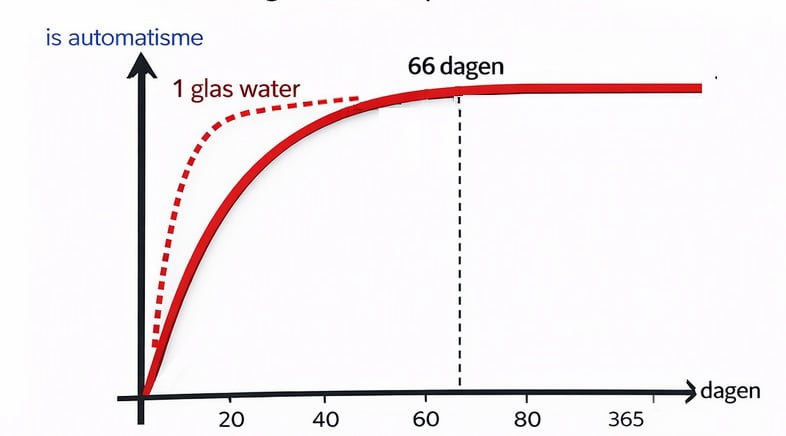
In a study by Philippa Lally (Pippa, see photo) it was investigated how long it takes for someone new to learn behaviour. Even with the most simple task – drinking a glass of water immediately after getting up – it takes almost 3 weeks for someone, without thinking about it, to automatically drink a glass of water upon waking. In short, drinking that glass of water has by then become a fixed (behavioural) pattern. 

An important confrontation

Here we see a graph illustrating Pippa's observations. We already need almost 3 weeks for the simplest task. For more difficult tasks, that duration increases rapidly. For most somewhat more difficult tasks, a period averaging 66 days was observed. But it can also involve a period of almost a year! Just think as an example of how difficult it is to break unwanted eating patterns.

Change often doesn't start with doing,
but by taking an honest look at why you aren't doing it.

Why is this part of the series important to you?

Perhaps you recognise this: you intend to do something differently… but after a while you fall back into your old pattern anyway. That is completely normal. It will also come as no surprise that you have encountered that relapse situation before. Habits simply run deep. They are driven not only by what you do, but also by what you think.

In this part of the series you will discover:

– why change is so difficult
– how your patterns work
– how you can break them

So that you not only start, but also keep going.

What are we going to cover?

Your thoughts and beliefs

Behind every habit lies a thought. Often these are sentences you say to yourself without noticing, such as:
“This helps me relax” or “I’ll start tomorrow”. These thoughts seem logical, but they aren't always.
They often actually help you to sustain your current behaviour.
In this part of the series, you will learn to recognise those thoughts. For only when you see what you are telling yourself can you change it. 
The first chapter deals with the question of how certain habits have become ingrained and why it is so difficult to break the unwanted ones.
In this chapter, we also look at what the epigenome has to tell us.

What works for you?
There is no single way that works for everyone. What works well for one person might not work at all for another.
Therefore, it is important to look at:

– what suits you
– what is feasible in your situation
– where you have the highest chance of success

In this section, you will learn to make choices that suit you. This increases the chance that you will actually stick with it.

Coping with difficult moments
Change almost never goes right the first time. Everyone has to deal with setbacks or difficult moments.
That's not a failure, but part of the process. What matters is what you do next:

– do you give up?
– or do you pick it up again?

In this section you will learn how to deal with such moments,
so that you don't relapse into your old pattern, but can move forward.

Duration and prior knowledge

No prior knowledge is needed to follow this part. Usually, your motivation to change a certain habit is already enough “fuel” to follow this part.

We estimate that it will take about 1 hour to go through this section. Of course, it might take longer if you want to explore certain topics in more depth, but that time will be well spent. 

Questions or assignments

In this course you will sometimes come across questions or assignments. Above all, do not be put off by them! You are under no obligation whatsoever, after all. They are purely intended as extra depth for anyone who fancies it. So please feel free to just skip them.